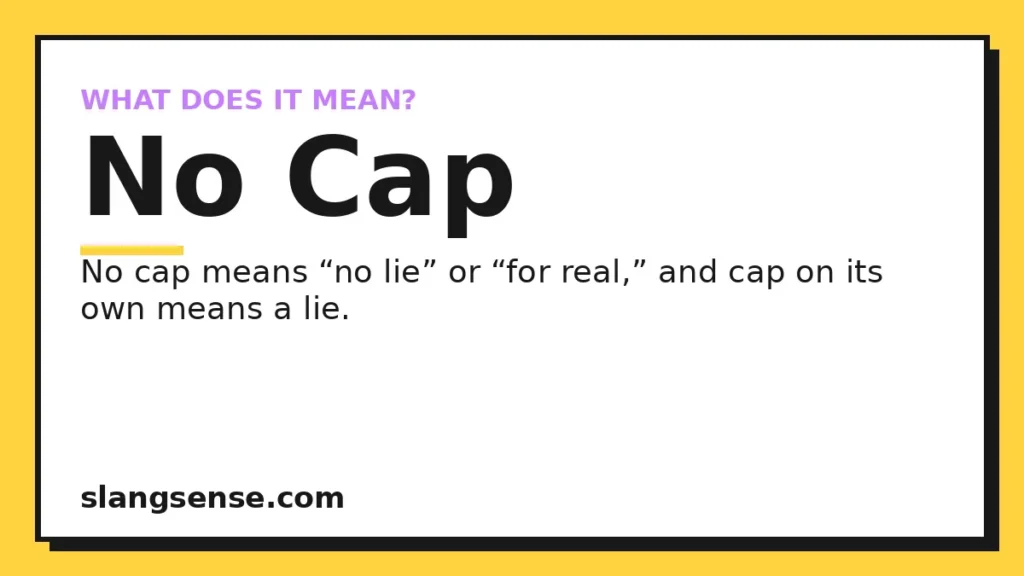
No cap means “no lie” or “for real.” People add it to a statement to show they mean it and are not exaggerating. On its own, cap means a lie or an overblown claim, so “that’s cap” means “that’s not true.” Online, the phrase is sometimes written with a no-entry sign next to a baseball cap emoji.
What does no cap mean in a text?
Dictionary.com defines no cap as “honestly; no lie; no exaggeration.” Merriam-Webster’s slang entry gives a similar sense, “genuinely; truthfully,” and says it is used to stress how sincere or serious a statement is. It can go before or after the claim, and it often comes with a question mark when someone wants to check that you are serious.
| How it is used | Example | What the sender means |
|---|---|---|
| Backing up praise | “best concert I’ve ever been to, no cap” | I really mean it, this is not hype |
| Vouching for a story | “no cap, I saw him at the airport” | Believe me, this actually happened |
| Checking | “you got the job? no cap?” | Are you serious? |
| Calling something false | “he said he can dunk. that’s cap” | That is not true |
| As a verb | “stop capping, you never met her” | Stop lying or exaggerating |
Most of the time no cap backs up good news, praise or a story that sounds hard to believe. It is less common in serious confessions, where people reach for plainer words. A line like “no cap, I’m proud of you” is both sincere and casual, which is a big part of the phrase’s appeal.
What does cap mean on its own?
Cap is the opposite half of the pair. It means a lie, a fake claim or a big exaggeration. “That’s cap” calls a statement false. “Capping” means lying or bragging, and “big cap” means a very obvious lie.
The cap emoji does the same job in comments. A reply that is just a baseball cap under someone’s post means “I don’t believe you.” It can be friendly teasing between friends, or a blunt way to call someone out in public.
Where does no cap come from?
The word cap has a long history in Black American slang. Dictionary.com says cap meant to brag, exaggerate or lie, a sense dating to the early 1900s. It adds that Green’s Dictionary of Slang records “to cap” meaning to surpass in the 1940s, linked to capping, a 1960s term for trading ritual insults. Merriam-Webster’s slang entry also ties the word to African American English, where cap meant to boast, exaggerate, lie or insult.
Dictionary.com suggests the root is cap in the sense of “top” or upper limit. To cap someone’s story was to top it, often with something less than true. No cap, then, means “I am not topping anything, this is straight.”
The phrase itself is closely linked to Atlanta hip-hop. Dictionary.com finds it on Twitter by at least 2012 and says it was likely spoken earlier. It was popularized in 2017, when the Atlanta rappers Young Thug and Future released a track called “No Cap.” From there it spread through social media and into school hallways far from Atlanta.
Is no cap rude?
No cap is not rude. It only adds weight to what you say. Cap is where things get sharper. Saying “that’s cap” to a friend about a fishing story is a joke. Saying it to a coworker about their sales numbers calls them a liar, and it will land that way.
Setting matters too. With friends, in group chats and in comments, both words are normal. Leave them out of emails to a teacher, a boss or a client, where “honestly” or “I can confirm” reads better. It is also worth remembering that the phrase comes from Black American speech, so it tends to sound forced when brands or adults use it to seem young.
How is no cap different from fr, ngl and ong?
All of these promise honesty, but each carries a slightly different weight. The table shows what each one adds.
| Term | Stands for | What it adds | Example |
|---|---|---|---|
| no cap | no lie | Stress that a claim is true | “that test was easy, no cap” |
| fr | for real | Agreement, or stress on the truth | “I’m tired fr” |
| ngl | not gonna lie | An honest view or small confession | “ngl I’m nervous” |
| tbh | to be honest | A plain opinion | “tbh I’d skip it” |
| ong | on God | A strong promise that it is true | “ong I didn’t touch it” |
Ngl and tbh are light and fit opinions and small truths. No cap is a little stronger, because it rules out exaggeration, not just dishonesty. Ong is stronger still, since the sender is swearing on God. Fr sits closest to no cap and the two often appear together, as in “no cap fr.”
Should parents worry about no cap?
No. The phrase has nothing hidden in it and no link to drugs, gangs or anything risky. It is a way to say “I mean it.” If a teen answers a parent with “that’s cap,” it is cheeky rather than sinister, and it means they think you are exaggerating.
For other short forms in a message, paste the text into our text slang translator and read it in plain English. It takes a few seconds and saves a lot of guessing.
How do you reply to no cap?
Answer the claim, not the phrase. The sender wants you to believe them, so react to what they said. These lines cover the common cases.
- Big praise: “this is the best pizza ever, no cap” gets “ok now I have to try it”
- A wild story: “no cap, a goose chased me to class” gets “wait, really? what happened?”
- Checking you: “you finished it already? no cap?” gets “no cap, it’s done”
- Something you doubt: “I ran a 5 minute mile” gets “that’s cap and you know it”
- Being called out: “that’s cap” gets “it’s true, I’ll show you the photo”
You can also send it back to agree. If a friend says “that movie was amazing, no cap,” a simple “no cap, it was” works. You will find more words like this in our Gen Z slang list, next to bet and sus.
Last checked: October 30, 2026.