
Hafa adai means “hello” in CHamoru, the native language of Guam and the Northern Mariana Islands. In the official spelling it is written håfa adai, and people say it to friends, guests and strangers alike. Word for word, it is close to “what, friend?”, a lot like saying “what’s up, friend?” in English. Below you will find what each word means, how to say it, and what to answer when someone greets you with it.
What do håfa and adai mean?
The first word is easy to pin down. The Chamoru.info online dictionary, which is built on Donald Topping’s Chamorro-English Dictionary and a 1918 dictionary by Edward von Preissig, defines håfa as “what.” It traces the word back to apa, the old Austronesian question word for “what.” That ancient root links CHamoru to other Pacific languages such as Samoan, where leai faafetai is the polite way to say no thank you.
The second word has two listings in the same dictionary. One is simply “friend.” The other is an exclamation like “for goodness’ sake,” which the dictionary says can also be a polite way to address a friend of the opposite sex who is about your age. Put together, the greeting works the way “hey, friend” does in English, and nobody stops to translate it piece by piece.
| Word or phrase | Meaning | Good to know |
|---|---|---|
| håfa | what | Also starts questions, as in “Håfa malago’-mu?” (What do you want?) |
| ådai | friend; also an exclamation | The dictionary writes it with the ring over the first a |
| håfa adai | hello | The full greeting |
| håfa dai / håfa dei | hello | The quick, casual way it sounds in speech |
The short forms in the last row show how the phrase sounds in real life. Both the online dictionary and Wikipedia list håfa dei as an everyday spelling of the same hello. That blending is a big clue to the right sound. So how do you say it without sounding like a phrasebook?
How do you pronounce hafa adai?
Say it as “hah-fah ah-dye,” and let the two words run together. The dictionary gives håfa as “hah-fah,” and the å letter stands for an open “ah” sound, like the a in “father.” The ending rhymes with “eye,” so adai never sounds like “a day.” The casual spellings håfa dai and håfa dei show the middle sound being dropped in quick speech.
A friendly try matters more than a perfect accent. Say it with a smile, the way you would say hi to a neighbor. The harder part for most people is the next line. What do you say when someone greets you first?
What do you say back to hafa adai?
The simplest reply is håfa adai right back. Saying the same greeting back is how hello works in most languages, and it is never wrong here either. If you want to keep talking, add a question about how the other person is doing. The table gives the common follow-ups, spelled the way Wikipedia and the Chamoru.info dictionary spell them.
| You want to say | In CHamoru | Plain English |
|---|---|---|
| Hello back | Håfa adai! | Hello! |
| How are you? (casual) | Kao mamaolek hao? | Are you doing well? |
| How are you? (polite) | Håfa tatatmanu hao? | How are you? |
| I’m good | Maolek. | Good, fine, well |
| Thank you | Si Yu’us ma’åse’. | Thank you |
| Bye | Adios. / Esta. | Goodbye |
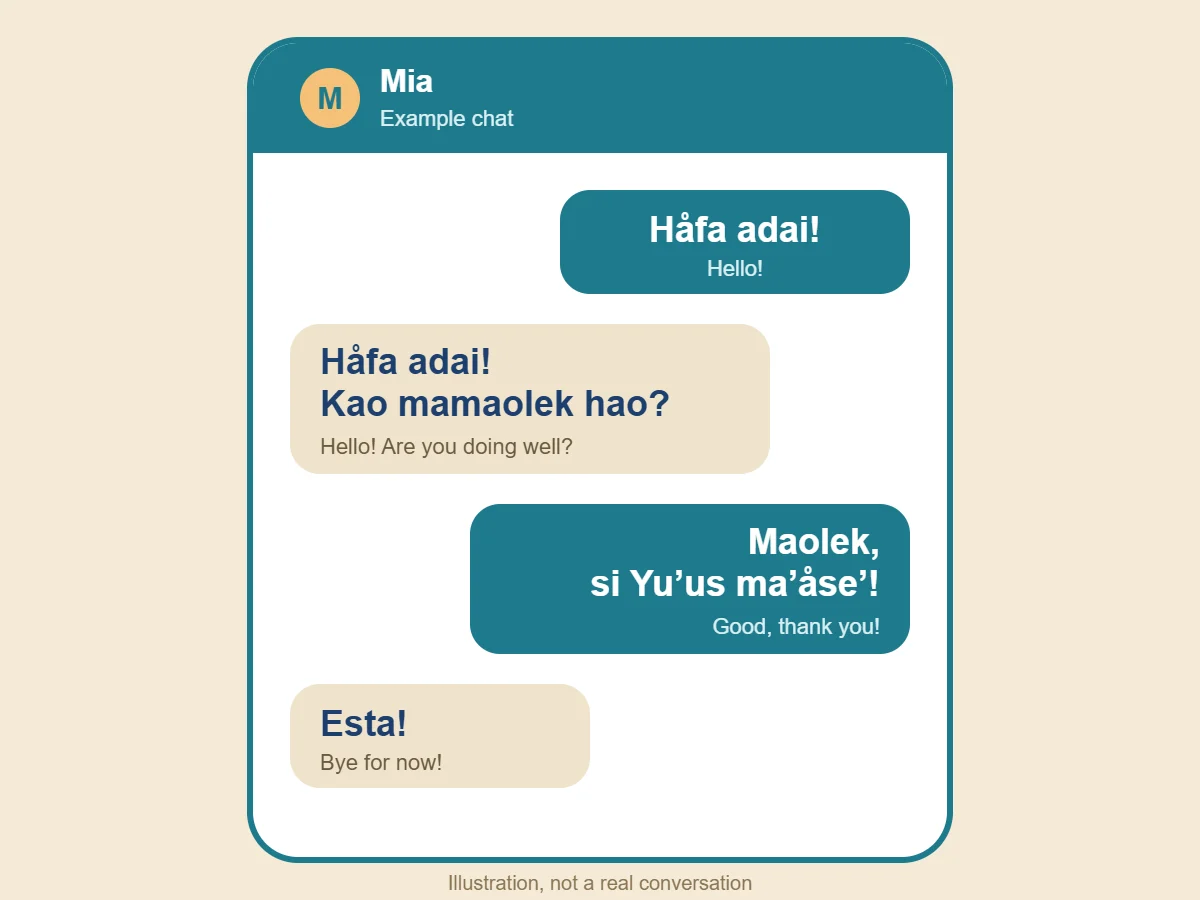
Thank you is worth learning on its own. The dictionary spells it si Yu’us ma’åse’ and says it sounds like “see-dzoo-oos-mah-uh-see.” It also lists si Yu’os ma’åse’ as a variant, so both spellings are fine. Word for word it means “God have mercy (on you),” but people use it for a simple thanks.
Where will you hear hafa adai?
Guam is the place most people link with the phrase. In July 2010, the Guam Visitors Bureau launched a Håfa Adai Pledge, which invites businesses to build island culture into how they work, KUAM News reported. A July 2015 bureau newsletter shows pledge signings at the Guam Micronesia Island Fair and at Chamorro Village. So the greeting is both an everyday hello and part of how the island welcomes guests.
The phrase is just as much at home in the Northern Mariana Islands, which include Saipan, Tinian and Rota. Wikipedia counts about 32,200 CHamoru speakers there and elsewhere, compared with about 25,800 on Guam. Its list of the Commonwealth’s symbols gives Håfa Adai as a nickname and says it is used on license plates. The hello belongs to the whole island chain, not just one island.
Is it håfa or hafa, CHamoru or Chamorro?
Both spellings are fine, and the difference comes from spelling rules, not meaning. Guam’s language commission, the Kumisión I Fino’ CHamoru, released its latest spelling standard in 2021, and Wikipedia says it uses the spelling CHamoru for the language. The Northern Mariana Islands revised their own official spelling in 2010. Wikipedia also notes that a and å are not always told apart in print, so hafa adai without the ring is common.
Online, many people type hafa adai, because the å is not on a standard keyboard. When you write for a Guam audience, håfa adai and CHamoru show care for the official spelling. When you text a friend, plain hafa adai is perfectly fine. Either way, you are using the same warm greeting.
What do buenas yan håfa adai and todu maolek mean?
You may hear buenas yan håfa adai. Buenas comes from Spanish, where it is a short way to say good day or good evening, and yan is the CHamoru word for “and.” So the line means something like “good day, and hello.” Mixing the two languages is normal, because Spanish rule began in 1668 and lasted on Guam until the United States took over in 1898.
That history left a deep mark on the language. Wikipedia cites an estimate that about half of CHamoru vocabulary comes from Spanish. Even two common goodbyes, adios and esta, came in that way. If a Spanish word in a message trips you up, our Spanish slang translator can help.
People also search for hafa adai todo mauleg. In the dictionary spelling that is todu maolek, where todu means “all” and maolek means “good.” Added to the greeting, it reads like “hello, all good.”
Can you greet someone in CHamoru?
Try four quick questions. Each one uses a fact from this guide, from the meaning of håfa to the right reply. A short note under each answer explains why it is right. Your score shows up at the end.
1. A shop clerk on Guam says “Håfa adai!” What is the easiest reply?
“Håfa adai!” is the easiest reply. Saying the greeting back works with anyone, while adios and esta are ways to say goodbye.
2. What does håfa mean on its own?
What. The Chamoru.info dictionary defines håfa as “what,” while ådai means “friend” and maolek means “good.”
3. Someone asks “Kao mamaolek hao?” and you feel fine. Which word fits?
Maolek is the word that fits. It means good, fine or well, while todu means “all” and yan means “and.”
4. True or false: hafa adai is only used on Guam.
False. It is also the everyday hello in the Northern Mariana Islands, where Håfa Adai is listed as a nickname used on license plates.
Can visitors say hafa adai?
Yes, and the greeting is meant to be shared. The Guam Visitors Bureau’s 2015 newsletter put it simply: “Sharing the Håfa Adai Spirit with Our Visitors and Each Other.” That line is the whole idea behind the pledge. Use the greeting the way you would any hello, with eye contact and a smile.
You may also notice a gesture of respect toward older people. Guampedia describes manginge’, a light touch of the nose to the back of an elder’s right hand, as respect shown to elders and people in authority. Guampedia discusses it in an essay on inafa’maolek, a CHamoru value whose name means “to make good” and which is about restoring harmony between people. If you see someone do it, that is what is going on.
Greetings like this one often turn up in captions and group chats next to texting slang. If a message mixes island words with short forms you cannot read, paste it into our text slang decoder. It will spell out the slang so you can focus on the greeting. Then you can answer with a håfa adai of your own.
Last checked: November 3, 2026.