
SMH means “shaking my head.” People type it when something is so silly, sad or annoying that words feel useless, the same way you might shake your head in real life. Merriam-Webster says it can show “bemused incredulity,” a mix of amusement and disbelief, or plain frustration and disapproval. The hard part is not the meaning but the target, because the head shake can point at the sender, at you or at the news.
What does SMH stand for in a text?
The three letters are short for “shaking my head,” and you will see them in capitals or in lower case with no change in meaning. The first Urban Dictionary entry, posted on February 14, 2004, put it as “shake my head,” for things too dumb for words. Merriam-Webster also lists a rarer reading, “scratching my head,” for when someone is confused rather than let down. So the meaning rarely changes, but who it is aimed at changes all the time.
Who is the SMH aimed at?
An SMH can point in a few directions, and the words around it tell you which one. If the sender is talking about their own mistake, the head shake is at themselves. If it comes right after something you said or did, it is at you. If it follows a news story or a bad day, it is at the situation, and nobody is in trouble.
| Who it is aimed at | Example message | What it signals |
|---|---|---|
| The sender | “Left my charger at home again smh” | Light embarrassment, usually a joke at their own expense |
| You | “You told her the ending?? smh” | Mild disapproval, or teasing if you are close |
| Someone else | “He still hasn’t paid me back smh” | Annoyance at a third person, and they want you to agree |
| The situation | “Gas went up again smh” | Shared frustration, with no one to blame |
Only the row aimed at you needs real care. Even then, most SMH messages between friends are teasing and not a real telling-off. Look at the message just before it in the chat, since that is almost always what it reacts to. Once you know the target, the next question is how hard the head is shaking.
How rude does SMH sound?
On its own, SMH is mild. It has no swear word in it, and it shows a reaction more than an attack. Know Your Meme puts it in the same family as the facepalm, the move where you cover your face because something is hopeless. Still, the way it is typed can push it from playful to cold, as the table below shows.
| How it is typed | How it usually reads |
|---|---|
| smh 😂 or smh 💀 | Teasing. The emoji says they are laughing, not upset. |
| smh (lower case, nothing else) | Mild. A small sigh about something silly. |
| smh 🤦 | Fed up, but usually not angry. |
| SMH. (capitals or a full stop) | Firmer. Real disapproval is more likely. |
| SMDH or SMFH | Stronger, with a swear word hidden in the letters. |
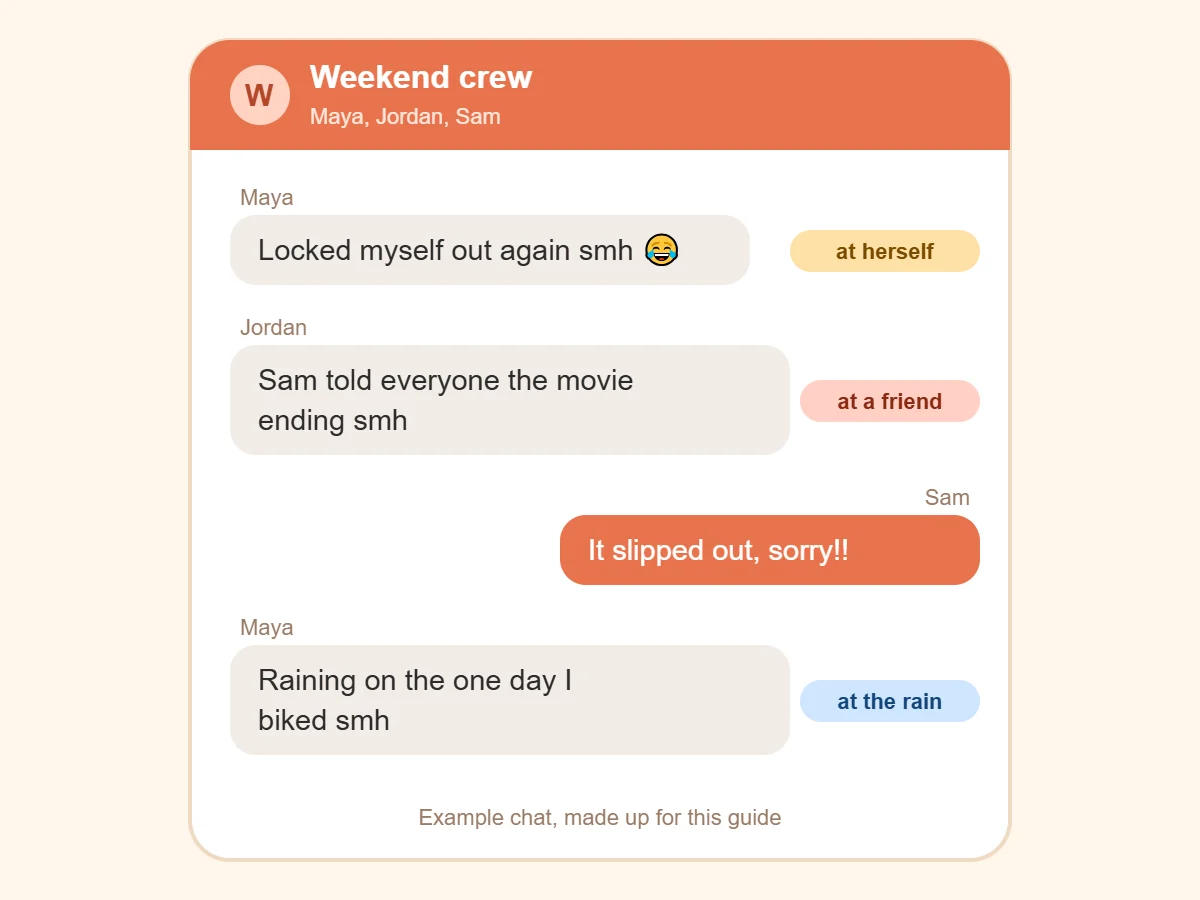
The same three letters carry three different feelings in that one chat. When a message has several short forms in a row and the tone is hard to read, paste it into our text slang decoder to see each one spelled out. Who sent it matters too. A friend who types smh all day is not saying the same thing as a boss who never uses it.
How do you reply to SMH?
Your reply depends on who the head shake was for. If it was at the sender, a light and kind answer works, because they are poking fun at themselves. If it was at the situation, agreeing is enough, since they just want someone to share the moment. If it was at you, work out whether it was teasing or real before you answer.
- At themselves: “Happens to the best of us 😂” or “Want me to bring you one?”
- At the situation: “Ugh, same” or “Right? It keeps getting worse.”
- At someone else: “No way, that’s not fair to you.”
- At you, as a joke: “Okay, okay, I deserved that.”
- At you, for real: “Fair, I messed up. Sorry.” or “Wait, what did I do?”
If you cannot tell which kind it is, asking is fine and usually clears things up fast. A short “Wait, are you mad or joking?” saves a lot of guessing. Try not to answer an SMH with a dry reply like mk, which can feel colder than you mean. Matching their energy with an emoji or a small joke keeps the chat friendly.
Is SMH OK at work, at school or with family?
SMH is casual, so keep it for friends, family chats and social media. In a work email or a message to a teacher, it can look like you are rolling your eyes at the person. If something at work really is frustrating, plain words such as “That’s frustrating” say the same thing without the attitude. With coworkers you are close to, a lower case smh about the broken printer is usually fine.
Parents who spot SMH on a child’s phone can usually relax, because the basic form has no swear word and no adult meaning in the dictionaries we checked. The longer forms are a different story, since some of them hide a swear word. Urban Dictionary also holds joke entries that claim odd meanings, so a quick search can be confusing. Merriam-Webster and Dictionary.com give the plain meaning if you want a calm second opinion.
SMDH, SMFH and the stronger forms
Extra letters make the head shake harder. Dictionary.com says the most common longer form is SMDH, “shaking my damn head,” and it also lists SMFH and SMMFH, which add stronger swear words. They work a lot like FFS, where the swear word sits inside the letters so it looks softer on the screen. The table sorts them from mildest to strongest.
| Form | Stands for | How strong | First Urban Dictionary entry |
|---|---|---|---|
| SMH | Shaking my head | Mild, no swearing | February 14, 2004 |
| SMDH | Shaking my damn head | Medium, a mild swear | July 22, 2007 |
| SMFH | Shaking my f***ing head | Strong swear | December 16, 2007 |
| SMMFH | Shaking my m***********ing head | Strongest | Not checked |
Where did SMH come from?
SMH is older than most people think. Merriam-Webster traces it to Usenet, an early network of online discussion groups, where a post in news.newusers.questions listed “SMH: shaking my head” on July 15, 1994. A post in the group sci.astro.amateur used it again on August 4, 1998, right next to LOL. So the term was around long before smartphones or social media.
The first Urban Dictionary entry came in 2004, and Dictionary.com says the term spread on Twitter by 2007. Dictionary.com adds that it may have started as an innovation of Black internet users. None of the sources we opened names a single inventor, so the first person to type it is unknown. You can see SMH next to other common short forms in our text abbreviations list.
What else can SMH stand for?
Outside of texting, SMH is the short name of The Sydney Morning Herald, an Australian newspaper founded in 1831. Wiktionary lists the Society for Military History under the same letters too. The clue is context: a news link or an Australian story points to the paper, while a reaction in a chat means shaking my head. Dictionary.com warns readers not to mix up the slang with the newspaper for exactly this reason.
Can you tell what this SMH means?
Try the four questions below and pick the answer that fits each one. Every answer comes with a short reason, so you can check your thinking. The questions use the clues from this guide: who the head shake is for, how it is typed and what came before it. Most people get them right once they look for the target first.
1. “Locked myself out again smh 😂” Who is the SMH aimed at?
The sender themselves. They are laughing at their own mistake, and the 😂 shows it is a joke, not a complaint.
2. What does SMH stand for in a text?
Shaking my head. Merriam-Webster and Dictionary.com both give this meaning.
3. Your boss writes “SMH.” after you send the wrong file. What is the best reply?
“You’re right, sorry. Here is the correct file.” A capital SMH with a full stop reads as real disapproval, so own the mistake and fix it.
4. Which form has a strong swear word inside it?
SMFH. The F stands for a strong swear word, while plain SMH has none.
Last checked: November 11, 2026.