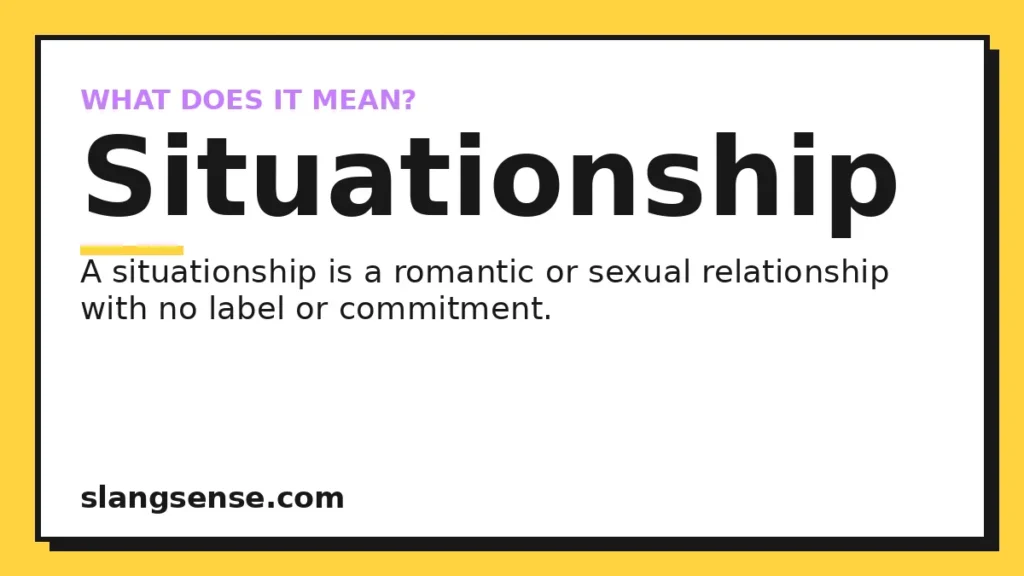
A situationship is a romantic or sexual relationship that has no clear label or commitment. Two people act a bit like a couple, texting often, going on dates or being physical, but have never agreed to be together. It sits somewhere between friendship and a relationship, and usually at least one person is unsure where it stands.
What does situationship mean?
Oxford University Press, which shortlisted the word for its 2023 Word of the Year, defined it as “a romantic or sexual relationship that is not considered to be formal or established.” Dictionary.com describes a situationship as “undefined and noncommittal.” The word blends situation and relationship. When someone says they are in one, these are the kinds of things they usually mean.
| Sign | Example | What it suggests |
|---|---|---|
| No label | “we’re not dating, we’re just… talking” | Neither person has said what this is |
| Last-minute plans | “u up? want to hang tonight?” | Plans happen when it suits, not ahead of time |
| Avoiding the talk | “why do we need a label?” | One person may not want commitment |
| Mixed signals | “he calls me babe but won’t meet my friends” | Closeness without commitment |
| Uneven hopes | “I think I want more than she does” | One person wants a relationship |
The word can also name a person. Merriam-Webster’s entry covers both the relationship and one of the people in it, so “my situationship texted me” means the person I am in a situationship with texted me. That use is common in group chats, where friends know exactly who is meant without anyone having to say a name or a title like boyfriend or girlfriend.
Not every sign has to be there. The core of a situationship is the missing agreement. Two people can be very close and still be in one if they have never said what they are.
Where does the word situationship come from?
Merriam-Webster’s entry gives 2008 as the first known use, and Dictionary.com says it was first recorded between 2005 and 2010. Dictionary.com notes the word stayed fairly obscure until the mid-2010s, when mainstream publications began explaining it. It was often used for relationships in which one person wanted more than the other offered.
By the early 2020s it was everywhere on social media, especially among young people describing their own love lives. Oxford put it on its eight-word shortlist in November 2023, alongside “rizz,” the eventual winner, as well as “Swiftie,” “beige flag” and “de-influencing.” That made it one of the best-known dating words of the decade.
How is a situationship different from dating or friends with benefits?
These arrangements can look alike from the outside. The difference is mostly in what the two people have agreed, or not agreed.
| Term | Commitment | Feelings | Is it clear? |
|---|---|---|---|
| talking stage | None yet, still getting to know each other | Growing | Clear that it is early |
| situationship | None agreed | Often present, sometimes uneven | No, that is the point |
| friends with benefits | None, by agreement | Friendship plus a physical side | Yes, both know it is not a couple |
| relationship | Agreed | Expected on both sides | Yes |
The key difference from friends with benefits is clarity. Friends with benefits is a deal both people understand. A situationship is defined by not having one. A talking stage is supposed to lead somewhere soon, while a situationship can drift for months.
Is a situationship bad?
Not necessarily. Some people prefer something loose, for example when they are busy, newly single or not ready for more. It can work well when both people truly want the same thing.
The trouble starts when the two people want different things and nobody says so. In a 2023 TIME piece quoted by Dictionary.com, writer Myisha Battle noted that “many daters still view situationships as deterrents from their dating goals.” The uncertainty is often the hardest part. People may hold back from dating others while waiting for a label that never comes.
For parents, teens use the word for the same thing adults do: an unlabeled romance. It does not mean anything physical is happening. If a teen mentions a situationship, a calm question about whether they feel good about it will usually tell you more than the word itself.
How do you end a situationship or make it official?
Either way, the answer is a direct conversation. It feels awkward, but it is the only thing that turns an undefined situation into a clear one. A few lines that work:
- To ask where it stands: “I like what we have. What do you want this to be?”
- To ask for more: “I’d like us to be exclusive. How do you feel about that?”
- To end it kindly: “I’ve realized I want a relationship, and I don’t think this is heading there.”
- To keep it casual on purpose: “I’m happy keeping things relaxed, as long as we’re both honest.”
Whatever the answer, you will know more than before. That alone often ends the anxiety that makes a situationship feel heavy.
Quick examples
Here is how the word turns up in everyday messages, and a reply that fits each one.
- “is he your boyfriend?” “no, it’s a situationship” gets “ah, so it’s complicated”
- “my situationship left me on read again” gets “that sounds frustrating, have you asked what he wants?”
- “I think I’m in a situationship and I hate it” gets “then it might be time for the talk”
- “ended my situationship today” gets “proud of you, that takes guts”
If a message about dating mixes in other slang, paste it into our text slang translator and read it in plain English.
Last checked: October 30, 2026.