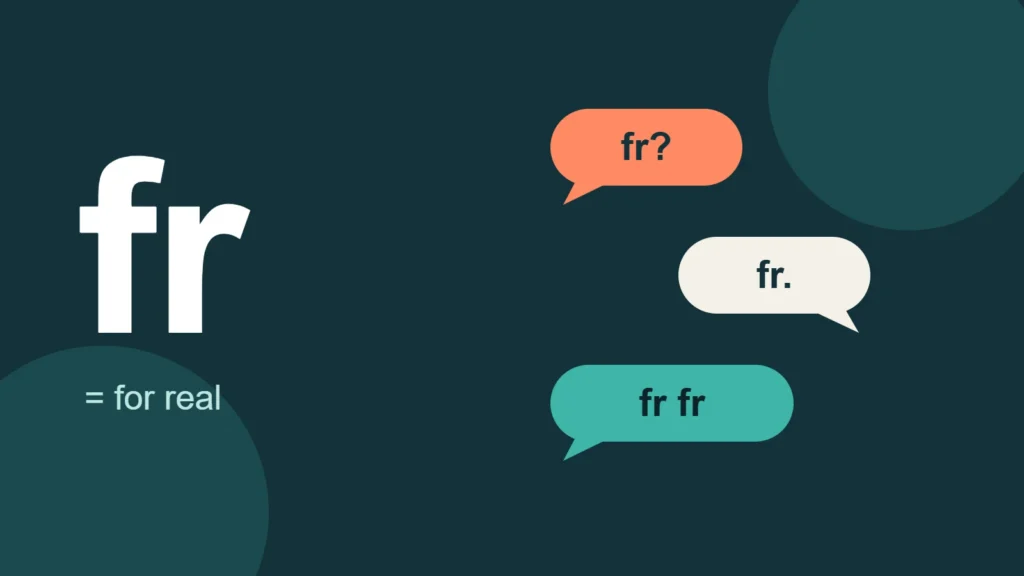
FR means “for real” in texts and on social media. People use it to say they are serious, to agree with someone, or to ask “really?” when news sounds hard to believe. Doubling it to “fr fr” turns the volume up, the same way saying “for real, for real” out loud does. Outside of chat, FR can also stand for France, French, a priest’s title or a friend request, and the clues below help you tell them apart.
What does fr mean in a text?
In most chats, fr is short for “for real.” Wiktionary lists it as an initialism of that phrase, which means the first letter of each word stands in for the whole thing. The phrase itself is much older than texting. Merriam-Webster labels “for real” as informal, gives senses like genuine, honest and in earnest, and dates its first known use to 1950.
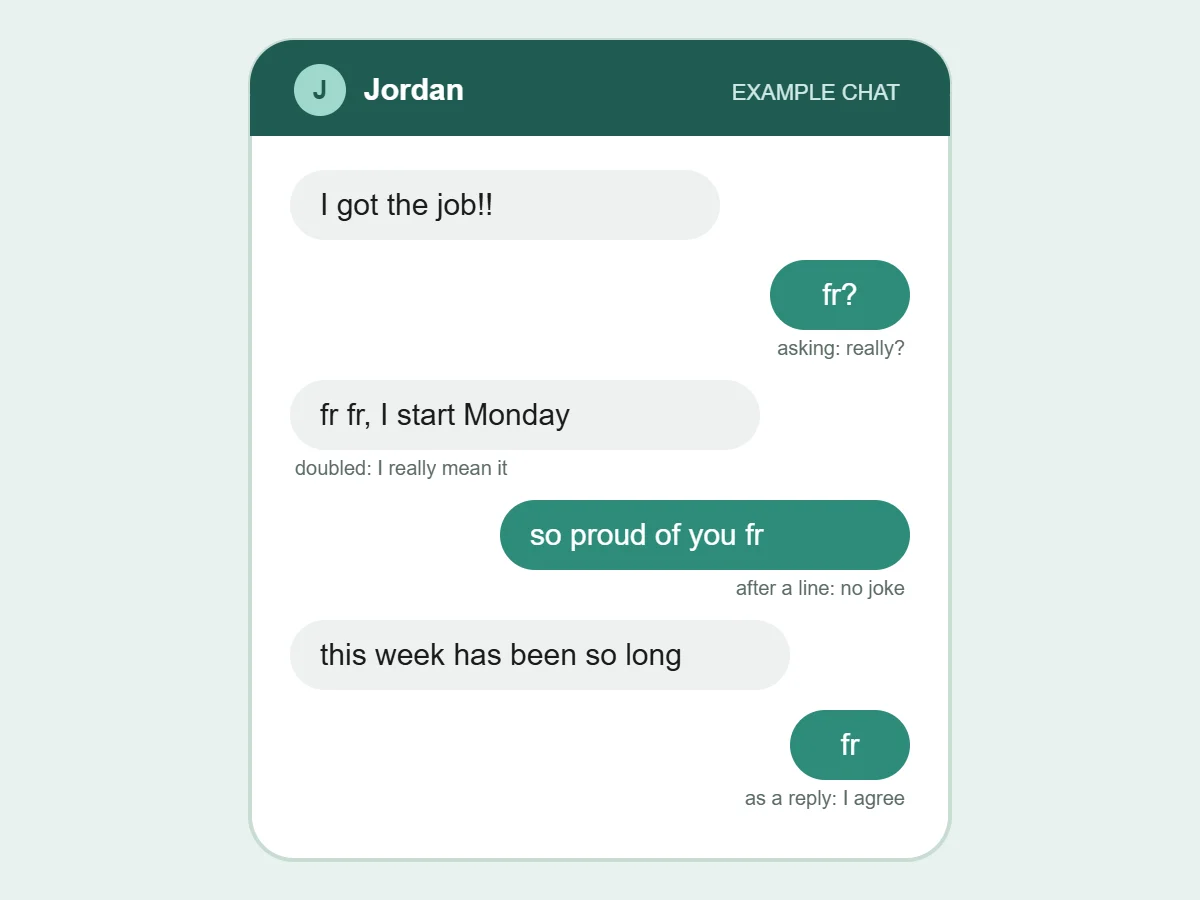
The job fr does depends on where it sits. Placed after a statement, it says “I mean this.” Sent alone with a question mark, it asks if the other person is serious. Sent as a reply to someone else, it simply agrees with them.
What does fr mean with a question mark, a period or doubled?
| How it looks | What it means | Example |
|---|---|---|
| fr? | Really? Are you serious? | “I quit my job today.” “fr?” |
| fr or fr. after your own line | I mean it, no joke | “I’m going to bed at 9 tonight fr.” |
| fr as a reply | I agree | “This class is so long.” “fr” |
| fr fr or frfr | I really, really mean it | “Best tacos I’ve ever had fr fr.” |
| fr!! | Strong agreement or excitement | “We got the tickets!” “fr!!” |
Punctuation does a lot of the work here. A question mark turns fr into a reaction of surprise, while a period or no mark at all makes it a calm statement. Extra exclamation marks add energy, not a new meaning. If the tone still feels unclear, read the message just before it, because fr almost always points back at that line.
Where did fr come from?
The phrase came first and the letters came much later. Know Your Meme, citing the Dictionary of American Slang, says “for real” grew out of the Yiddish phrase “for true?” and was used in America in the 1940s. That is earlier than Merriam-Webster’s 1950 date, so the exact start is not settled. Both sources agree that people said it out loud for decades before anyone typed fr.
The short form shows up online early in the texting era. The oldest Urban Dictionary entry we found that defines FR as “for real” is dated October 28, 2003. The doubled “frfr” has an entry from January 27, 2010. These dates show that people were already using the terms by then, not the day anyone invented them.
What does fr fr mean?
Fr fr means “for real, for real.” Wiktionary calls frfr a reduplication of fr, which is a fancy way of saying the word is repeated to make it stronger. It works like saying “I’m serious, I’m so serious.” Know Your Meme says the doubled form started showing up in tweets in 2014 and credits Vine captions, though it gives no proof for that link.
You will also see it stacked with other slang from our Gen Z slang list. Lines like “fr fr ong” or “fr fr no cap” pile up promises to sound extra sincere, and Urban Dictionary has entries for both from 2023 and 2024. Most of the time this is playful rather than truly serious. Think of a friend raising a hand to swear, half joking and half meaning it.
Which FR is it? Other meanings to know
Not every FR is slang. Merriam-Webster lists fr as a short form of father, friar, franc and from, and Fr as short for France, French and Friday. Gamers use FR for a friend request, a meaning Urban Dictionary recorded on Xbox Live and gaming forums in 2008. The table shows where each one turns up and the clue that gives it away.
| Meaning | Where you see it | The clue |
|---|---|---|
| For real | Texts, TikTok comments, group chats | Lowercase, at the end of a line or sent alone |
| Friend request | Games, Discord, social apps | “Send me an FR” or “accept my FR” |
| France or French | Flags, language menus, website addresses | Next to EN or ES, or .fr at the end of a web address |
| Father (a priest) | Church notices, school letters | “Fr.” right before a name, as in “Fr. Michael” |
| From | Quick notes and labels | “Notes fr class” or “fr: Sam” |
| Friday | Schedules and timetables | Listed with other days, as in “Mo Tu We Th Fr” |
| Front engine, rear-wheel drive | Car forums and reviews | Next to words like layout, drift or sports car |
When in doubt, look at the capital letters and the words around it. Slang fr is nearly always lowercase and sits next to an opinion or a feeling. A capital FR beside a flag, a name or a car is almost never slang. That one check clears up most mix-ups.
How is fr different from ngl, tbh, istg and ong?
These words all promise honesty, but they do it in different ways. Fr says “this is real,” while ngl admits something you might have kept quiet. Istg and ong add a swear on something, so they sound stronger and a bit more dramatic. Picking the right one is mostly about how hard you want to push.
| Term | Stands for | What it adds | Example |
|---|---|---|---|
| fr | for real | “I mean this” or “really?” | “That movie was good fr.” |
| ngl | not gonna lie | An honest confession | “ngl I liked the ending.” |
| tbh | to be honest | A gentle opinion | “tbh I’d skip it.” |
| istg | I swear to God | A strong promise, often dramatic | “istg I’m never eating there again.” |
| ong | on God | A swear that it is true, often stacked | “fr fr ong” |
If you are unsure, fr is the safest of the group. It has no swear in it and no confession, so it fits nearly any casual chat. Istg and ong carry a religious word, and some people would rather not see it used lightly. Our guide to what istg means covers that stronger cousin in detail.
How do you reply to fr?
Your reply depends on which fr you got. If it came with a question mark, the person wants to know if you are serious, so confirm it or laugh it off. If it came after their own strong opinion, they want you to agree or push back. If it came as a reply to you, they already agree and the chat can move on.
- To “fr?”: “fr, I’m not joking” or “lol no, just kidding”
- To “this is the best pizza in town fr”: “agreed, it’s so good” or “nah, the other place wins”
- To a plain “fr” after your message: “right?” or simply move to the next thing
- To “fr fr”: treat it as extra serious and answer the point itself
Is fr rude, or okay to use at work?
Fr is not rude, and there is no swear word hidden inside it. Still, it is casual, and How-To Geek advises keeping fr and frfr out of the workplace and other professional settings. In a team chat with coworkers who already talk this way, a quick “fr” is usually fine. In emails, school essays or messages to a boss you barely know, write “really” or “I agree” instead.
For parents and teachers, fr is one of the easy ones. In normal chat it means “for real” and nothing more, even though Urban Dictionary holds a few rare joke and insult readings. Pay attention to the words around fr, not to fr itself. To decode a whole message at once, paste it into our free text slang translator.
Can you tell which fr is which?
Try these four lines to check yourself. Each one uses FR in a different way, from a surprised question to a gaming invite. Tap an answer to see if you got it and why. If scripts are off, the answer shows under each question.
1. “My mom said I can’t go tonight.” “fr?”
Are you serious? Sent alone with a question mark, fr asks if the other person really means it.
2. “Send me an FR so we can play later.”
A friend request. The words “send me” and “play” point to a game or an app, not to slang.
3. “That concert was amazing fr fr.”
They really, really mean it. Doubling fr makes the promise stronger, like saying “for real, for real.”
4. True or false: How-To Geek suggests using fr in work emails.
False. How-To Geek advises keeping fr and frfr out of the workplace and other professional settings.
Last checked: October 18, 2026.