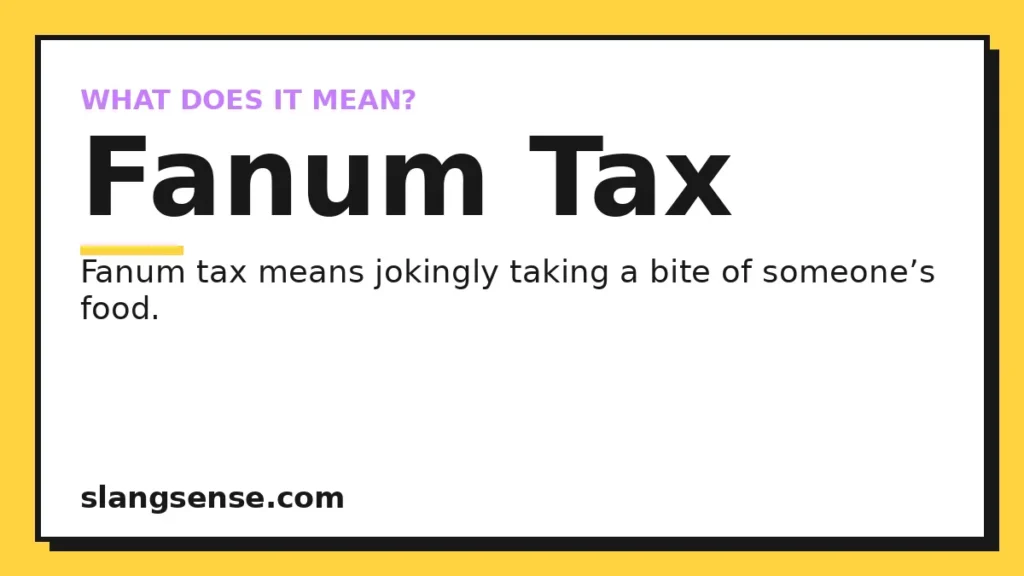
Fanum tax means taking some of someone else’s food, usually as a joke between friends. If you open a bag of chips and a friend grabs a handful, they have just charged you the Fanum tax. The name comes from Fanum, a streamer known for swiping bites of his friends’ food on camera.
What does fanum tax mean in a text?
Merriam-Webster’s slang entry calls it a humorous internet slang term for stealing someone’s food, or another item, or being entitled to some of it. It also notes that the phrase is widely used as a nonsensical meme. Wikipedia’s article on Fanum sums it up as internet slang for taking or sharing someone’s food.
| How fanum tax is used | Example | What the sender means |
|---|---|---|
| Claiming a bite | “fanum tax” (under a photo of fries) | I’m taking some of that |
| Warning a friend | “hide your snacks, he charges the fanum tax” | He will eat your food |
| Complaining | “my little brother fanum taxed my pizza” | Someone took my food |
| Borrowing something else | “fanum tax on your hoodie” | I’m keeping this for a while |
| Random meme talk | “fanum tax” as a reply to almost anything | Nothing much, it is just a joke |
The joke is in the framing. A tax is something you are required to pay, so calling it a tax treats the stolen fry as fair and official. Most of the time the person “paying” plays along.
Who is Fanum?
Fanum is an American streamer from the Bronx in New York City. According to Wikipedia, he is a member of AMP, short for Any Means Possible, a streamer group whose collaborative challenge videos have large followings. He often appears on Twitch streams with fellow creator Kai Cenat, and those streams are where the tax began.
Where does fanum tax come from?
Wikipedia says the term first referred only to Fanum, who playfully took bites of other creators’ snacks during live streams. It circulated within AMP in late 2022 and became widely known through his streams with Kai Cenat, where he took Cenat’s cookies. Clips of those moments spread across TikTok and YouTube.
Part of the appeal was how ordinary it was. Anyone who has had a sibling or roommate reach into their plate recognized the move at once, and the clips gave that everyday annoyance a funny official-sounding name.
Then the phrase left its fan base behind. Wikipedia notes that a TikTok video posted on 2 October 2023, a parody built around a Fortnite character, spread it further. It has since become a fixture of Gen Alpha slang, and Merriam-Webster now lists it in its slang section. Many kids who say it have never watched a single stream.
Is fanum tax rude?
Usually it is friendly, about the same as asking to share a snack. Between friends, taking one fry and saying “fanum tax” is a joke both sides enjoy. It turns rude when it stops being sharing: taking someone’s whole lunch, grabbing food from someone who clearly did not want to share, or always taking from the same person. The funny name does not change whose food it is.
Some people also find the joke wears thin. Hearing “fanum tax” every time you open a snack can feel less like a game and more like being targeted, especially for a younger sibling or the quiet kid at the lunch table.
A simple rule keeps it fun: ask first. “Can I fanum tax you?” keeps both the joke and the manners. Most people will say yes to one fry.
Should parents worry about fanum tax?
Not about the phrase itself. It is playful and has no hidden meaning. Two things are worth a look, though. If one child keeps “taxing” another child’s food, that can be a quiet way of picking on someone, and it is worth a word with a teacher. And since the term comes from streaming culture, it is a natural way to ask your child which streamers they watch and what they like about them.
How is fanum tax different from mooching and dibs?
A few words cover food that changes hands. The table shows where fanum tax fits.
| Term | What it means | Example |
|---|---|---|
| fanum tax | Jokingly taking part of someone’s food | “fanum tax, one nugget” |
| mooching | Taking from others without giving back | “stop mooching my snacks” |
| dibs | Claiming something before anyone else | “dibs on the last slice” |
| sharing | Offering food freely | “want some?” |
You will also see the tax charged on things other than food, from a borrowed charger to a sip of a drink. Merriam-Webster’s definition allows for that, since it covers food or another item. The idea stays the same: a small, cheeky share of something that is not yours.
Dibs is a claim made before the food is up for grabs, while the fanum tax is taken from food that already belongs to someone. The difference from mooching is tone. The fanum tax is meant as a joke, and mooching is a complaint.
How do you reply to fanum tax?
You can pay it, dodge it or tax them back. Here are some easy replies.
- Paying up: “fanum tax” gets “fine, one fry, that’s it”
- Dodging: “fanum tax” gets “tax season is closed”
- Saying no: “fanum tax?” gets “not today, get your own”
- Getting in first: “I’m eating, no fanum tax allowed”
- Taxing back: “ok, then I’m taxing your drink”
However you answer, keep it light, since the whole point of the phrase is the joke. For other slang in a message, paste the text into our text slang translator and read it in plain English.
Last checked: October 30, 2026.