
Ching chong is a racist slur that mocks the sound of Chinese and is aimed at people of East Asian descent. It is not a real Chinese phrase, and it has no meaning in any Chinese language. People say it to make Asian people sound foreign or silly, often while copying an accent. That is why it hurts, even when the person saying it calls it a joke.
You may have seen it in a meme, a game chat or a song title and wondered what it means. This guide explains where the sounds come from, who the slur targets and how long it has been around. It ends with what to do if someone says it to you, your child or your team. If the same message had other slang in it, our text slang decoder can explain the everyday terms.
Does “ching chong” mean anything in Chinese?
No. Ching chong is a made-up string of sounds that copies how Chinese can sound to English speakers. Wikipedia describes it as a mocking imitation of Mandarin and Cantonese sounds. Wiktionary traces it to syllables such as qing and chong in Mandarin and cing and cong in Cantonese, helped along by common surnames like Cheng and Chung.
Some sites, including an older version of this page, have said the words mean something like “eat that punch.” That idea comes from typing the sounds into a translation app, which will always give some answer. A guess from a translation tool does not turn random sounds into a real phrase. Chinese speakers do not use “ching chong” as a phrase, so there is nothing to translate.
The form changes, but the job stays the same. People stretch it into “ching chang chong” or add more fake syllables to sound “more Chinese.” In 2011 a UCLA student added “ling long” and “ting tong” in a viral video rant, which is the same trick. The table below lists the forms you are most likely to see.
| Form | Where it shows up | What it is |
|---|---|---|
| ching chong | Insults, memes, game chat, comments | The main slur, used as a fake word or as a name for an Asian person |
| ching chang chong | Playground taunts, joke videos | A longer version of the same mock sounds |
| “Ching Chong Chinaman” rhymes | Children’s rhymes recorded from the 1880s to the 1940s | Taunts that pair the sounds with threats or violence against a Chinese man |
| “ling long,” “ting tong” and similar | Rants that copy an accent | Extra fake syllables added to the same mockery |
| zhing-zhong | Zimbabwe | Slang for cheap Chinese goods, also used at times as an insult for Chinese people |
Who is the slur aimed at?
It is aimed first at Chinese people, but it hits anyone who looks East Asian to the speaker. Wiktionary lists it as mocking Chinese, Korean, Thai or other East or Southeast Asian speech. Mary Paik Lee, a Korean girl whose family arrived in San Francisco in 1906, later wrote that girls chanted it at her on her first day of school while hitting her. The speaker rarely checks where someone is from before saying it.
The harm goes past hurt feelings. In their book Asian Americans and the Media, Kent Ono and Vincent Pham say this kind of mimicry marks Asian people as outsiders, as NPR’s Code Switch reported in 2014. The Asian American Journalists Association made a similar point in 2006, saying it treats Asian Americans as foreigners or second-class citizens. Wikipedia also notes that the phrase has at times come with assaults and physical threats.
Where did ching chong come from?
The slur is at least 140 years old in the United States. It grew out of anger at Chinese workers, who came in large numbers for the gold rush and the railroads in the mid-1800s. In 1882 the Chinese Exclusion Act blocked Chinese laborers from moving to the country. Henry Carrington Bolton’s 1886 book of children’s counting rhymes recorded a “Ching, Chong” rhyme that ends by telling a Chinese man to clear out.
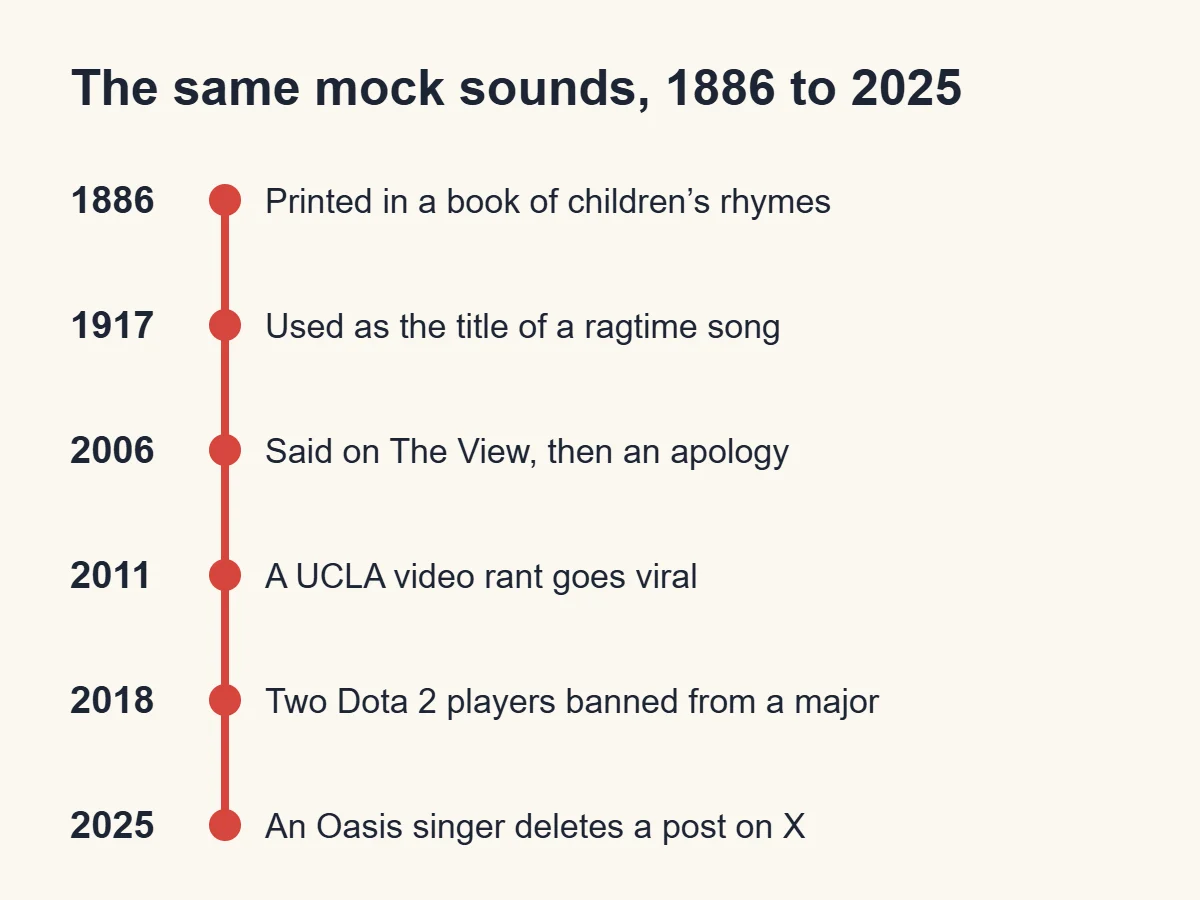
The sounds then moved into songs, books and TV. A 1917 ragtime song by Lee S. Roberts and J. Will Callahan was even titled “Ching Chong.” In John Steinbeck’s 1945 novel Cannery Row, a boy chants a version of the old rhyme at a Chinese man. The timeline below picks out moments when the phrase made the news.
| Year | What happened | What followed |
|---|---|---|
| 1886 | Henry Carrington Bolton’s book records a “Ching, Chong” counting rhyme from the Pacific coast | NPR’s Code Switch quoted it in 2014 when tracing the slur’s roots |
| 1917 | Lee S. Roberts and J. Will Callahan publish the ragtime song “Ching Chong” | NPR and Wikipedia both show its sheet music cover |
| 2002 | NBA star Shaquille O’Neal says it about Yao Ming in a TV interview | He called it locker-room humor and later apologized |
| 2006 | Rosie O’Donnell uses it on The View to mimic Chinese news anchors | She apologized and said she had not known it was offensive |
| 2011 | A UCLA student mocks Asian students and their speech in a viral video rant | Musician Jimmy Wong answered with a parody song, and the student left the school |
| 2014 | A Colbert Report tweet uses it in a joke about a charity | The #CancelColbert hashtag spread online |
| 2018 | Two Filipino Dota 2 players type it at Chinese players during matches | Both were banned from the Chongqing Major |
| 2025 | Liam Gallagher of Oasis uses it in a post on X | He deleted the post and apologized |
Is ching chong a bad word, or “just a joke”?
It is a bad word, and almost every famous case ended with the speaker saying it was a joke. Shaquille O’Neal called his line locker-room humor. Rosie O’Donnell said she had no idea the phrase was offensive until people told her it was as bad as the N-word. Yao Ming said he believed O’Neal was joking, but that many Asian people would not see the humor.
Intent does not change what the words do. The person on the receiving end has often heard the same sounds since childhood, sometimes from people who meant real harm. In 2006 Guy Aoki of the Media Action Network for Asian Americans said it was on the same level as the N-word. You do not have to agree with that comparison to see why a joke built on it lands badly.
Where you might see it today
The slur still shows up where people feel anonymous. Online games have produced several of the best-known recent cases, and pro esports leagues have punished it. In 2014 Riot Games fined and suspended a pro League of Legends player who put it in an account name. Bing search data also shows many people looking for “ching chong” songs on YouTube.
Slurs also hide in usernames, receipts and short codes, which is why moderators and parents should know them. In February 2025 a burger shop in Queenstown, New Zealand, apologized after a worker labeled a customer “ching chang” on a receipt, and the worker was fired. The same trick shows up in acronyms and license plates, such as the slur tucked inside FYRTRD. Knowing the pattern helps you spot it before it spreads in a group.
What to do if someone says it to you or around you
What you do depends on who said it and where. Your safety comes first, so you never owe a stranger an argument. With friends, family or teammates, a short and calm reply often works better than a long debate. The table gives a starting point for the most common cases.
| Situation | What you can do | Something you can say |
|---|---|---|
| A stranger says it to you in public | Move away and get somewhere safe, then write down the time and place. Report it if you felt threatened. | Nothing, if speaking up feels unsafe |
| A friend says it “as a joke” | Tell them plainly that it is a slur, then move on. | “That one’s a racist slur. Please drop it.” |
| A teammate types it in game chat | Mute and report the player, and keep a screenshot. | “Not cool. Reported.” |
| Your child repeats it | Ask where they heard it, then explain who it hurts and why. | “Those sounds make fun of how Asian people talk. We don’t say that.” |
| You said it before and did not know | Stop using it and apologize if someone was hurt, without excuses. | “I didn’t know what it meant. I’m sorry, and I won’t say it again.” |
Kids sometimes pick it up from a video or a game without knowing what it is. A calm talk usually works better than a punishment the first time. Explain that it copies how a group of people speak in order to laugh at them. For the other words in your child’s messages, our Gen Z slang list explains the everyday terms in plain English.
Can you spot the facts about ching chong?
Test what you learned with four quick questions. Each one comes from a fact covered above. Tap an answer to see whether you got it right and why. If scripts are off, the reasons show under each question.
1. Someone online says ching chong means “eat that punch” in Chinese. Are they right?
No, it is made-up sounds that mock how Chinese sounds. A translation app will give an answer for random sounds, but that does not make them a real phrase.
2. Who gets targeted with this slur?
Chinese people and other Asians the speaker sees as Chinese. Mary Paik Lee, a Korean girl whose family came to San Francisco in 1906, had it chanted at her at school.
3. How old is this taunt?
At least 140 years. Henry Carrington Bolton’s 1886 book of children’s rhymes recorded a “Ching, Chong” rhyme aimed at Chinese workers.
4. A teammate types it in game chat after losing to a Chinese team. What is it?
A racist slur that pro leagues have punished. Two Filipino Dota 2 players were banned from the 2018 Chongqing Major for typing it, and Riot Games fined and suspended a pro player in 2014.
Last checked: November 21, 2026.