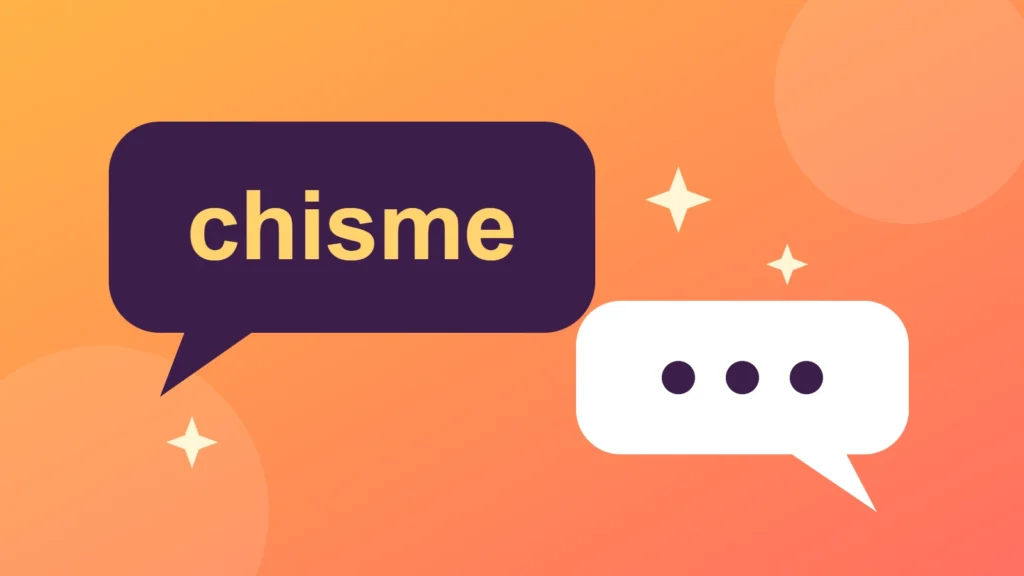
Chisme means gossip in Spanish: news or talk about someone who is not there to hear it. You will hear it in Spanish, and you will also hear it dropped into English, as in “okay, I have chisme.” In Spain the same word can also mean a small thing or gadget, a meaning most guides skip. Below you will find how to say it, how to use it, and what the related words mean.
What does chisme mean in English?
The closest English word is gossip. The Real Academia Española, the main dictionary of Spanish, gives a sharper definition. It calls chisme news, true or false, or a remark usually meant to turn people against each other or to talk about someone behind their back. So chisme is not just any news, it is news about a person.
It is pronounced CHEES-meh, with two syllables. SpanishDict gives the same sound for Latin America and Spain. The word is masculine, so it is “el chisme” and, for more than one, “los chismes.” You can also use it like a mass noun, the way English says “some gossip.”
In English slang, the nearest match is tea. “Spill the tea” and “give me the chisme” ask for the same thing, and tea has its own entry in our Gen Z slang list. The difference is mostly who says it. Chisme carries a Spanish-speaking flavor, so it shows up a lot when people mix Spanish and English in one sentence.
How do you use chisme in a sentence?
Most of the time, chisme is the thing being shared. People have it, want it, ask for it and tell it. The phrases below are the ones you are most likely to see in texts and comments. Each one is easy to copy into your own chats.
| Phrase | What it means | Example |
|---|---|---|
| Tengo chisme | I have gossip to tell you | “Llámame, tengo chisme.” |
| Cuéntame el chisme | Tell me the gossip | “¿Qué pasó? Cuéntame el chisme.” |
| ¿Cuál es el chisme? | What’s the gossip? | “Everyone is quiet, ¿cuál es el chisme?” |
| Puro chisme | Nothing but gossip, so not to be trusted | “Don’t believe it, es puro chisme.” |
| Chisme de vecindad | Gossip about small things (the RAE lists this phrase) | “It’s just chisme de vecindad about the new car.” |
Notice that most of these lines come from someone who wants to hear the story. Asking for chisme is often playful, and friends say it with a grin. Spreading chisme about someone who could get hurt is a different thing, and the word does not hide that. The tone comes from what the story is and who it hurts.
What is a chismosa or chismoso?
A chismosa is a woman or girl who gossips, and a chismoso is a man or boy who does. Both come from chisme plus an ending that means “full of” or “given to.” Calling a friend chismosa can be a joke between people who love a good story. Said to someone you do not know, it can land as an insult.
In some countries the word has a harder edge. The RAE lists a second meaning, marked as an insult, used in Mexico, Puerto Rico, the Dominican Republic, Colombia and several other countries: an informer, or someone who tells on others. In Cuba, a chismosa can also be a homemade kerosene lamp. So the same word can mean a gossip, a snitch or a lamp, depending on where you are.
The verb is chismear, which means to gossip. The RAE describes it as talking about someone or their business without care, or with bad intent. A related word you may meet is chismorreo, the act of gossiping. If you want to say you do not like drama, “no me gusta el chisme” works.
Can chisme mean a thing or a gadget?
Yes, mostly in Spain. SpanishCentral marks this meaning as Spain and informal, and gives the example “¿y este chisme para qué sirve?” That means “and what is this thing for?” The RAE agrees that a chisme can be a cheap trinket or small piece of junk.
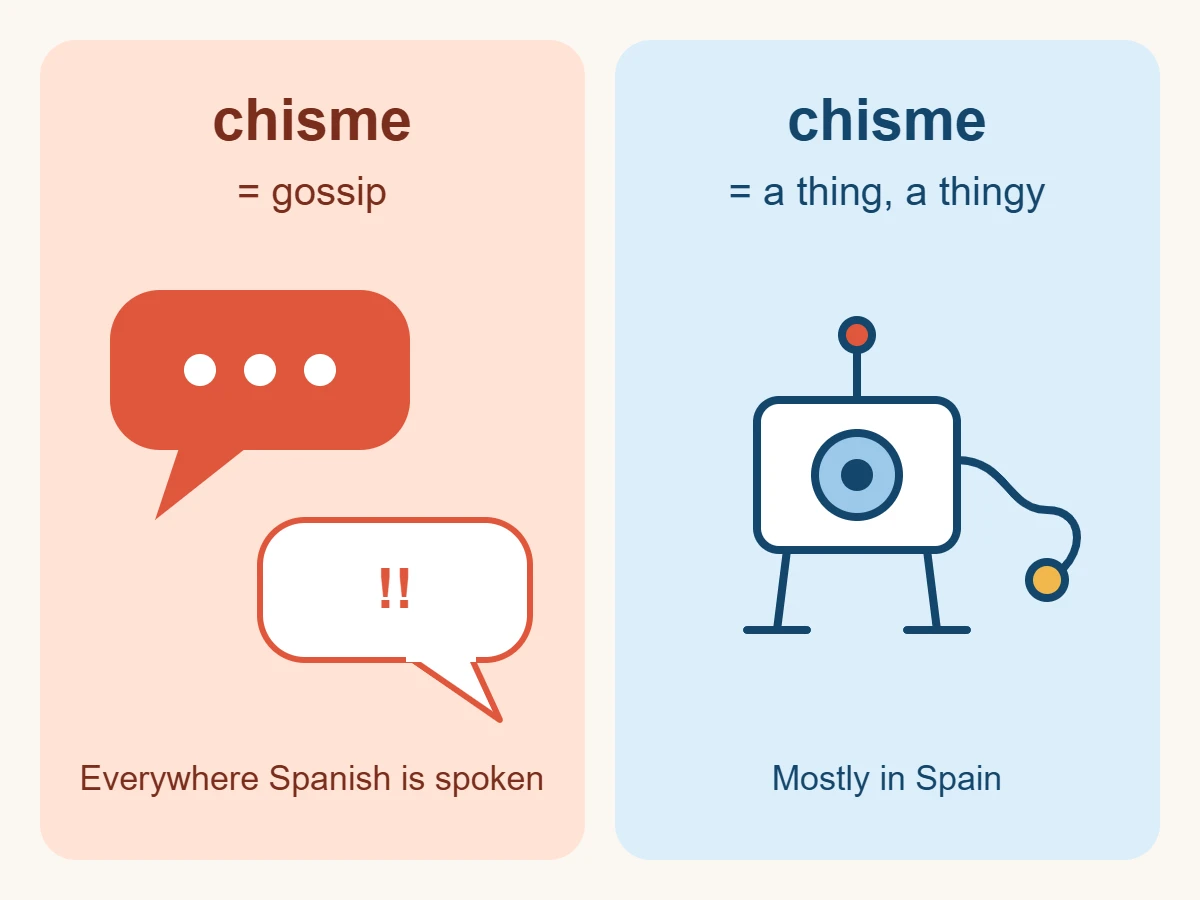
This second meaning works like “thingy” or “thingamajig” in English. You use it when you cannot remember the name of an object, or when the object is a little silly. If someone in Madrid asks you to pass “ese chisme,” they want the object, not a story. SpanishCentral ties this meaning to Spain, so elsewhere the gossip meaning is the safer guess.
Where does the word chisme come from?
Experts do not agree. The RAE says chisme comes from the Latin word schisma, which came from Greek and means a split or separation. That fits the idea that gossip can split people apart. Our older version of this page gave a different origin, and that one has support too.
Wiktionary reports that the word-origin scholar Joan Coromines thought another path was more likely. In this view, chisme grew out of an old Spanish word for bedbug, which came from the Latin cimex. Wiktionary calls the origin “uncertain,” and that is the honest answer. Both stories are about something small that causes trouble.
Why do people say chisme is part of Latino culture?
Chisme is often treated as more than a word in Latino families. In 2022, the public radio show Latino USA made a full episode called “Chisme: An Ancestral Language.” It described chisme as talking about someone when they are not there, and it explored why the habit is so central in many Latinos’ lives. The title alone shows how much weight the word carries.
When the show aired the episode again in August 2025, its page called chisme a language that has bonded Latinos for generations. That does not mean every Latino loves gossip, and the word is not a label to pin on people. Chisme can also hurt, which is why calling someone a chismosa is often a warning. Both sides are part of the word.
Chisme also sits next to other Spanish words that English speakers borrow. No bueno is one of them, used in English to say something is bad. Like chisme, it moves easily between the two languages in one sentence. Words like these are part of how bilingual people talk every day.
Can you tell which chisme is which?
Try four quick questions on the meanings above. Pick the answer you think fits, and a short note will explain it. The notes also stay on the page if the quiz does not load. See how many you get right.
1. A friend texts: “Ven, tengo chisme sobre la vecina.” What does she have?
Gossip about the neighbor. “Tengo chisme” means “I have gossip,” and “sobre la vecina” means “about the neighbor.”
2. In Madrid, someone holds up a strange tool and asks, “¿y este chisme para qué sirve?” What is chisme here?
A thing, like “thingy” in English. In Spain, chisme can mean a small object or gadget, and the question asks what it is for.
3. In Mexico, calling someone a chismoso can mean a gossip or what else?
An informer, someone who tells on others. The RAE lists this second meaning as an insult used in Mexico and several other countries.
4. True or false: experts agree on where the word chisme comes from.
False. The RAE says it comes from the Latin schisma, while Joan Coromines leaned toward an old word for bedbug.
If you hear chisme mixed with other Spanish slang and get lost, our Spanish slang translator can help. Paste the line and it will explain the words in plain English. It is handy for comments and group chats where two languages mix. For chisme itself, you now know both meanings and the words that grow from it.
Last checked: October 13, 2026