

A super senior is a student who stays in high school or college longer than the usual four years, so they spend a fifth year, or more, as a senior. In high school, the label often means someone who needs more credits to graduate. In college, it is more neutral, because many students simply take longer to finish a degree. In sports, a super senior is an athlete who keeps playing an extra season after their class has moved on.
The phrase can be a plain description or a light tease, and the setting tells you which. A counselor who says it is just naming a situation, while a friend in a group chat is usually joking about age. It is school slang more than internet slang, yet it shows up in the same chats as the words in our Gen Z slang guide. So the first thing to sort out is where you heard it.
Super senior in high school, college and sports: what changes?
The word senior means the last year of a program, which is grade 12 in an American high school and the fourth year of a bachelor’s degree. Wikipedia’s article on the term says super senior mostly describes college students who take extra courses, though people use it for high schoolers too. Some coaches and sports writers say fifth-year senior instead. The table sorts out who the label fits in each setting.
| Setting | Who gets called a super senior | Common reasons | How it sounds |
|---|---|---|---|
| High school | A student in a fifth year of high school | Missing credits, a move, an illness, or a chosen extra year | Often teasing |
| College | An undergraduate past four years | A new major, a job on the side, a double major | Mostly neutral |
| College sports | An athlete using an extra season | A redshirt year, an injury, or the COVID-19 extra year | Respectful, even proud |
| Canada (Ontario) | A graduate who comes back for another year | Better marks or more courses, called a victory lap | Neutral |
So the same two words can carry very different weight. A fifth-year college student is common, while a fifth-year high schooler stands out more. That gap is why the label can feel harsher in a high school hallway than on a campus. But how many students actually need that extra year?
Why do students become super seniors?
In high school, most students finish on time, but not all of them. The National Center for Education Statistics reports that 87 percent of public high school students graduated within four years in the 2021–22 school year. Some of the rest stay on to earn the credits they are missing. Others come back on purpose, for example to raise their grades before they apply to college.
College is a different story, because finishing in four years is far from certain. The same agency found that 64 percent of students who started a bachelor’s degree in fall 2014 finished it at the same school within six years. Switching majors, taking fewer classes to hold a job, or adding a second major can all push graduation into a fifth year. Wikipedia also points out that many super seniors stay by choice, to take more courses or earn extra credentials.
Canada has its own name for the same idea. In Ontario, an extra year of high school is often called a victory lap, and CBC News reported that about 20,000 students who had already graduated went back in a single year. Wikipedia notes that the province set a 34-credit limit in September 2013 to cut down how long students could stay. Sports add one more reason to stay, and that one comes with its own rules.
What does super senior mean in college sports?
In college sports, a super senior is a player in a fifth year or later who can still compete. The most common route is a redshirt, which Wikipedia describes as a pause in an athlete’s playing time that stretches out their eligibility. Eligibility is the number of seasons a player is allowed to compete, usually four. The table below explains the labels you will see on team rosters and in game coverage.
| Term | What it means |
|---|---|
| Redshirt | A year when an athlete trains with the team but does not play, so the season is saved for later |
| Redshirt senior | A fifth-year student playing a fourth season |
| Fifth-year senior | A fifth-year student who is still allowed to compete |
| Super senior | A catch-all word for these players, used a lot for the COVID-19 extra year |
The term spread widely after COVID-19 cut seasons short in 2020. On March 30, 2020, the NCAA Division I Council voted to give spring athletes whose seasons were canceled an extra year, The Stanford Daily reported that day. Fall athletes got the same deal from the NCAA board on August 21, 2020, and winter athletes, such as basketball players, followed on October 14, 2020. Wikipedia notes that some athletes even played a seventh season in 2021–22 under these waivers.
By 2025, that group was nearly gone. A March 2025 story from Cal Lutheran University called its returning players “the last of their kind,” since the extra year was running out. Many of those players were in graduate programs while they kept competing. Off the field, though, the word can still sting, which raises a fair question.
Is it bad to be a super senior?
No, being a super senior is not a failure, even though people sometimes use the label that way. Wikipedia mentions the stereotype of a student who could not finish on time, then notes that many take the extra year on purpose. Plenty of college students, working adults and athletes are in exactly this spot. A fifth year is a detour, not a dead end.
Slang adds the teasing side. The earliest Urban Dictionary entry we found, from January 3, 2004, describes a high schooler in a fifth year or later and jokes that they are on the five-year plan. Later entries pile on jokes about scruffy beards, rarely showing up to class and still being in high school at 19 or 20. In a group chat, friends may also call a super senior unc, a word that teases someone for seeming old.
A few Urban Dictionary entries also tie the term to an older student who dates a freshman or an eighth grader. That is the joke at its worst, and it points to a real concern for parents and teachers. An age gap of four or five years matters a lot when one person is 14. If a super senior is chasing a much younger student, a calm talk with that student, and with the school if needed, is a good first step.
How to reply when someone calls you a super senior
The right reply depends on who said it and how. A friend who is joking usually wants a joke back, while a rude comment from a stranger needs no answer at all. If you are fine with your reason for staying, saying it plainly tends to end the teasing fast. Here are replies that fit common situations.
| Situation | Example message | A reply that fits |
|---|---|---|
| A friend teasing | “lol super senior, do you get a parking spot for life?” | “Five years of experience, show some respect 😎” |
| A new classmate asking | “Wait, are you a super senior?” | “Yep, I needed one more year of credits. Almost done!” |
| A teammate | “Super senior szn, last ride?” | “Last ride. Let’s make it count.” |
| Someone being mean | “Imagine still being in high school at 19” | No reply, or “I’m finishing. That’s what counts.” |
| A parent or relative | “So you’re a super senior now?” | “Yes, I’m taking an extra year to finish my major.” |
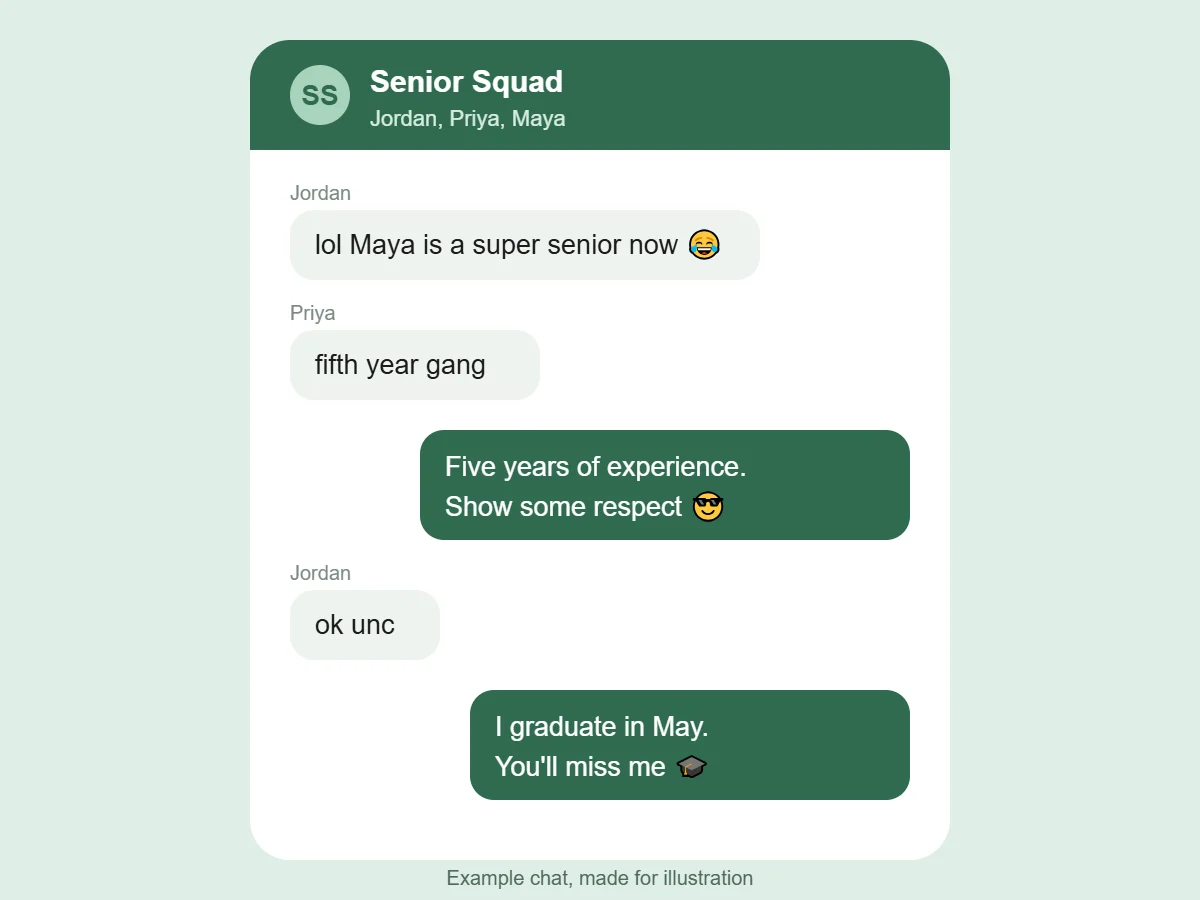
If a message mixes this term with other slang you do not know, paste it into our text slang decoder for a plain-English reading. It works on whole texts, not just single words. That can stop you from answering a joke as if it were an insult. Ready to test what you learned?
Can you tell what super senior means in these messages?
These four questions use the situations from this guide. Pick an answer and the reason appears right away. Your score shows once you finish all four. There is no timer, so take your time.
1. “Our quarterback is a super senior, he’s been on the team since 2019 🏈”
A college athlete playing an extra season. In sports, super senior means a player in a fifth year or later, often after a redshirt or the COVID-19 extra year.
2. A college student switched majors twice and is now in a fifth year. What are they?
A super senior. Any undergraduate past the usual four years can be called one, and a change of major is a common reason.
3. In Ontario, what do students often call an extra year of high school?
A victory lap. That is the Canadian name for going back to high school for another year, often for better marks or more courses.
4. True or false: being a super senior always means you failed.
False, many students stay on by choice. Some need more credits, while others stay to take more courses, raise grades or play another season.
Last checked: November 17, 2026.