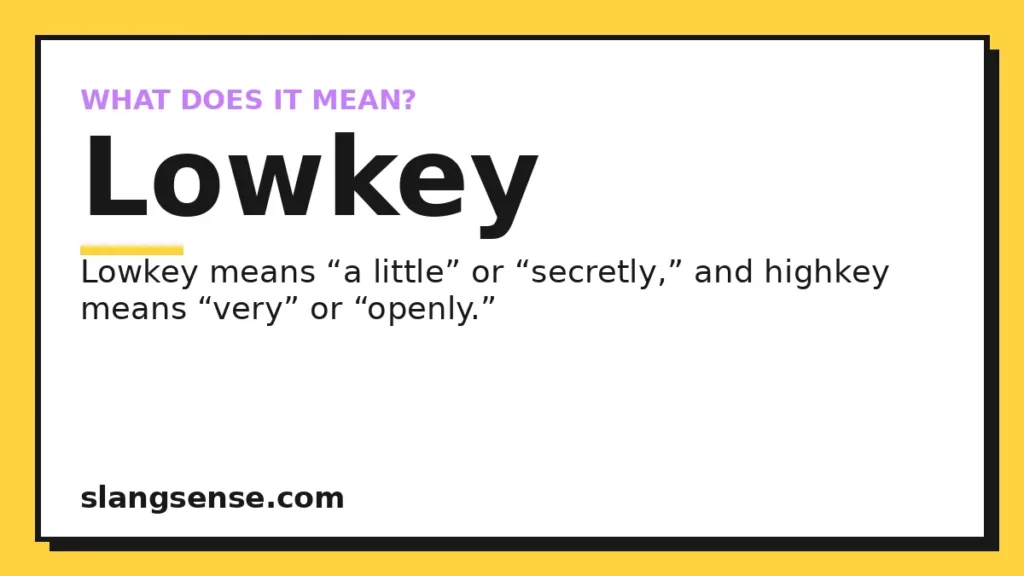
Lowkey means “a little,” “kind of” or “quietly.” People use it to soften a statement or admit something without making a fuss: “lowkey hungry” means somewhat hungry, and “I lowkey like this song” means I like it but I am not shouting about it. Highkey is the opposite and means “very” or “openly.”
What does lowkey mean in a text?
In texts, lowkey is mostly an adverb. Merriam-Webster’s “Words We’re Watching” note describes it as meaning something like “subtly” or “in a veiled way,” and Dictionary.com glosses the adverb as “of low or moderate intensity.” The older adjective, as in a low-key party, still means quiet and relaxed. In chats the word does a few different jobs.
| What lowkey is doing | Example | What the sender means |
|---|---|---|
| Softening | “lowkey tired today” | I am a bit tired |
| Admitting | “I lowkey cried at that ending” | I did, but I am not making a big deal of it |
| Keeping something quiet | “keep it lowkey, it’s a surprise” | Do not tell everyone |
| Describing a plan | “a lowkey birthday dinner” | Small and relaxed, no fuss |
| Playing it down | “lowkey the best day of my life” | A huge deal, said casually on purpose |
The last row trips people up. Many people put lowkey in front of something they feel strongly about. That is understatement for effect, the same way someone might call an amazing meal “not bad.” The words after lowkey usually tell you whether the sender means a little or a lot.
What does highkey mean?
Highkey turns the volume up. Merriam-Webster’s slang entry describes it as meaning roughly “truly,” “completely” or “intensely,” and says it is often used to stress how sincere or intense a statement is. “Highkey obsessed with this show” means very obsessed, and happy for everyone to know.
| Phrase | Lowkey version means | Highkey version means |
|---|---|---|
| “___ nervous” | A bit nervous | Very nervous |
| “I ___ want to go” | I would quite like to go | I really want to go |
| “___ a fan” | A quiet fan | A loud, open fan |
| “___ annoyed” | Slightly bothered | Clearly annoyed |
Highkey is much less common than lowkey. You will mostly see it as a playful contrast, often right after someone has used lowkey, as in “lowkey? no, highkey.”
Where does lowkey come from?
Low-key is far older than texting. Dictionary.com traces it to an early 19th-century musical sense meaning “of a low pitch,” and notes that Charles Dickens used it in Martin Chuzzlewit in 1844 for a muted tone of voice. By the 1890s it had taken on the familiar sense of quiet, restrained or modest, as in a low-key wedding. About a century later it also came to mean easygoing.
The adverb is newer. Dictionary.com points to tweets from 2009 that use low key to mean “somewhat” or “quietly,” and Merriam-Webster gives 2010 as the first known use of the adverb. Dictionary.com says hip-hop helped spread it in the mid-2010s. Today lowkey, written as one word, is the usual form in chats, while hyphenated low-key is still standard in edited writing.
Is it lowkey, low-key or low key?
All three spellings are in use, and they mean the same thing. Dictionaries list the hyphenated form, low-key, which is what you will see in newspapers and formal writing: “a low-key ceremony.” In texts and comments most people run the two words together as lowkey, and some leave a space. Nobody will read a different meaning into your choice.
Highkey follows the same pattern. It also shows up as high-key or high key, though it is rare in edited writing. If you are writing a school essay or a work email, skip the slang adverb and use a plain word such as “somewhat,” “quietly” or “really.”
Is lowkey rude or flirty?
Neither on its own. It is one of the most neutral slang words around. When it softens criticism, as in “lowkey didn’t love the movie,” it is often kinder than saying the same thing flat out.
It can carry a hint of flirting when it is about feelings. “I lowkey missed you” is a gentle way to say “I missed you” without putting pressure on the other person. The word does not decide the meaning, the relationship does. From a close friend it is warmth. From someone you have been talking to romantically, it may be a way of testing the waters.
“Keep it lowkey” about a plan or a relationship means keep it private. For parents, that is the one use worth noticing. A teen asking for something to stay lowkey is asking for discretion, which is usually harmless, like a surprise party, and sometimes worth a calm question.
How is lowkey different from kinda, ngl and highkey?
Lowkey often sits where other short words could go, but each one changes the message a little.
| Term | What it adds | Example |
|---|---|---|
| lowkey | A soft or quiet admission | “lowkey want pizza” |
| kinda | Plain softening | “kinda want pizza” |
| ngl | An honest opinion or small confession | “ngl I want pizza” |
| highkey | Strong emphasis | “highkey want pizza” |
Lowkey and ngl often appear together, as in “ngl I lowkey liked it.” The sender is being honest and playing the feeling down at the same time. Kinda is the plainest of the group and fits in almost any message.
Quick examples and how to reply
Reply to the feeling, and match the sender’s level. If they played something down, you can too.
- “lowkey bored, wanna call?” gets “sure, give me five minutes”
- “I lowkey miss you” gets “I lowkey miss you too” or “highkey same”
- “keep it lowkey, she doesn’t know yet” gets “my lips are sealed”
- “lowkey didn’t like the ending” gets “same, it felt rushed”
- “highkey obsessed with this song” gets “send it, I need to hear it”
If a message mixes several short forms, paste it into our text slang translator and read it in plain English.
Last checked: October 30, 2026.