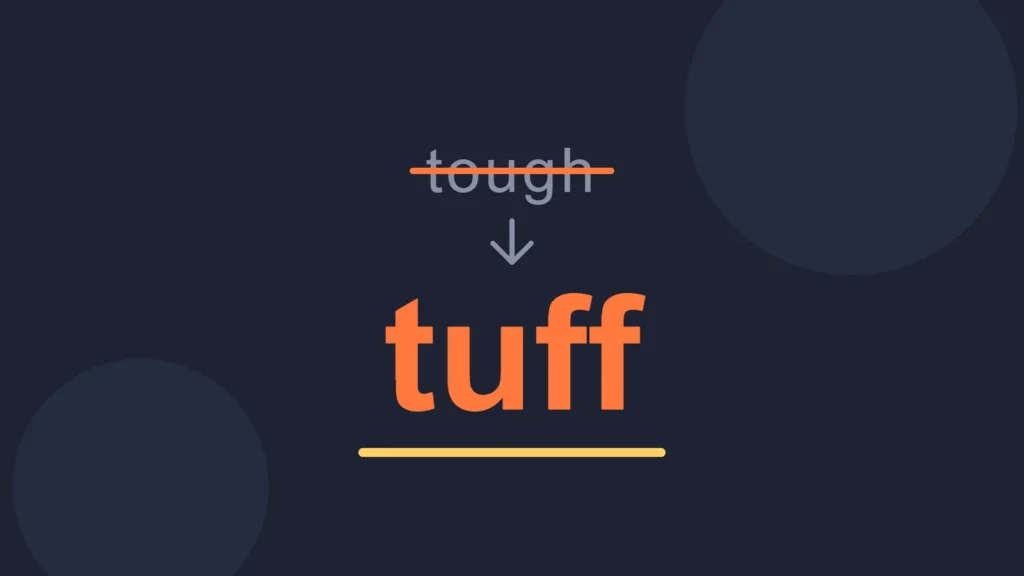
Tuff means cool, impressive or really good. It is a playful spelling of “tough,” so “that fit is tuff” is a compliment. The same word has a second job, though. When someone answers bad news with “that’s tuff,” they mean “that’s too bad,” and sometimes they mean they don’t care much.
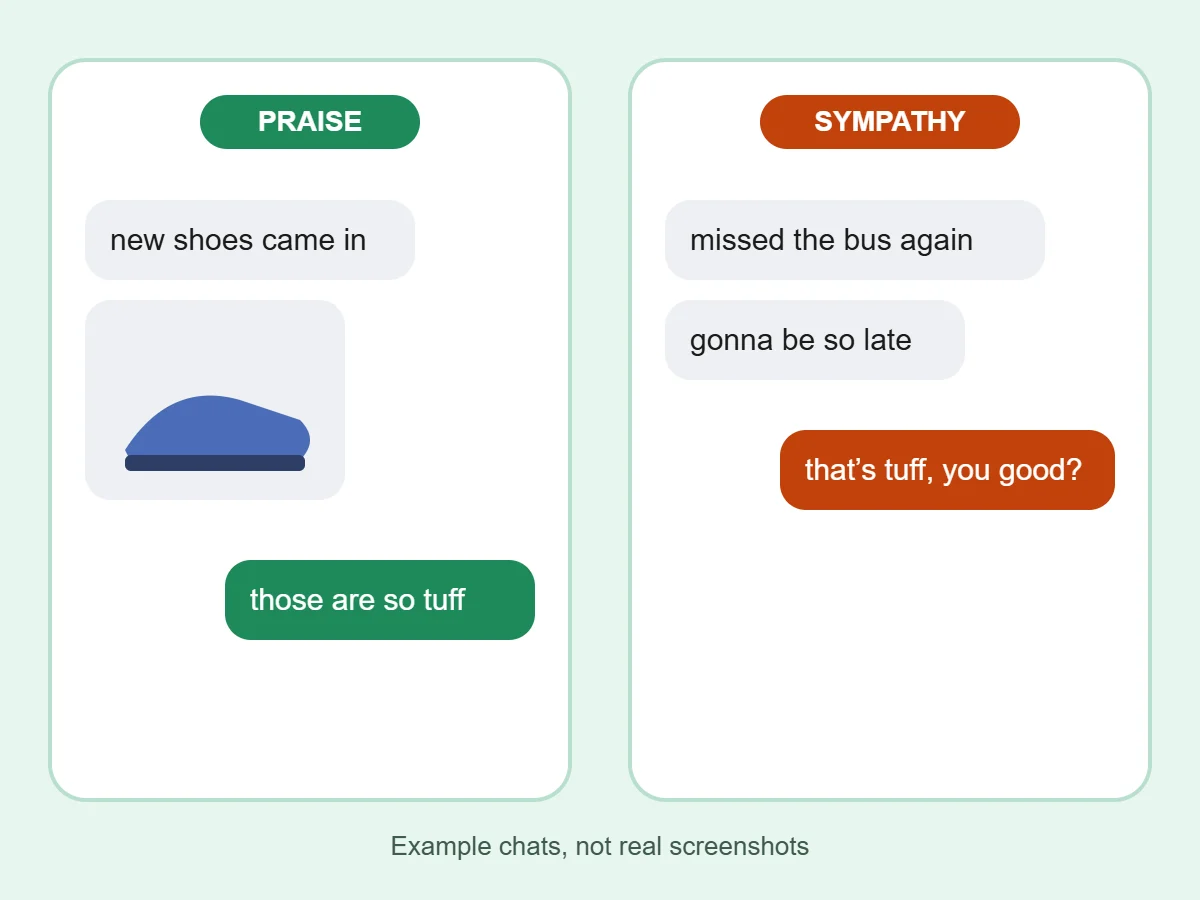
Most of the time, the words around tuff tell you which one you got. Praise points at a thing someone shows off, like a song, a photo or a move in a game. The “too bad” sense comes right after a problem or a complaint. The table below sorts the uses you will see most.
Tuff meaning: the uses you will see
| How it shows up | What it means | Example | Tone |
|---|---|---|---|
| “so tuff” or “tuff” about a thing | Cool, great, impressive | “This beat is so tuff.” | Warm praise |
| “that’s tuff” after bad news | That’s too bad, sorry | “Lost my phone on the bus.” “Dang, that’s tuff.” | Kind, a bit casual |
| “that’s tuff” after a small complaint | Too bad, not my problem | “The line was long.” “That’s tuff.” | Teasing or cold |
| “tuff” for “tough” | Hard or difficult | “Today was tuff.” | Plain, just a spelling |
| tuff in a science class | A rock made of volcanic ash | “The cliff is made of tuff.” | Not slang at all |
Merriam-Webster has a slang page for tuff and calls it an all-purpose word for things like cool and awesome. Its examples come from many places, from a Reddit comment about an outfit to a team account cheering a basketball play. The rock meaning is much older and has nothing to do with the slang. Merriam-Webster dates the rock word to 1815, and you will only meet it in geology.
How do you tell “so tuff” from “that’s tuff”?
Start with what came right before the word. If someone posted a picture, a song or a highlight, tuff is almost always praise. If someone just shared a problem, “that’s tuff” is a reaction to the problem. The word “that’s” is a strong clue, because it points back at the news, not at a thing being admired.
Next, look at what comes after it. Kind replies usually keep going, with a question or an offer like “you good?” or “want me to come over?” A cold “that’s tuff” tends to stand alone, with nothing after it and the topic changed. Emoji help too, since a fire emoji leans toward praise and a crying face leans toward sympathy.
Where did tuff come from?
Tough has had a good side for a long time. Green’s Dictionary of Slang lists “tough” in the sense of admirable or excellent, and it labels that use as Black American and college slang. The spelling “tuff” is old too. Etymonline calls it an advertiser’s spelling of tough and dates it to at least 1940.
By the late 1960s, tuff was teen slang for cool. Green’s earliest example comes from a 1968 book called Hy Lit’s Unbelievable Dictionary of Hip Words, which defines it as fabulous and groovy. A year earlier, S.E. Hinton’s novel The Outsiders made the spelling famous. Its narrator, Ponyboy, explains that tough means rough while tuff means cool or sharp, and he treats both as compliments.
That is the answer for anyone searching what tuff meant in the 1960s. It meant cool, sharp or great, much like it does now. Know Your Meme traces today’s slang roughly back to The Outsiders. The 1983 movie version of the book kept the word in front of new readers and viewers.
Why does “that’s tuff” mean “too bad”?
This part comes from a different, older phrase. People have said “tough luck” since the 1800s, and Green’s finds it in an Atlanta newspaper in 1876. “That’s tough” followed, with an early example in a 1934 novel by James T. Farrell. Merriam-Webster notes that “tough luck” can show real sympathy, or it can be said with irony when the speaker does not feel sorry at all.
So “that’s tuff” is just the old phrase in the new spelling. On Urban Dictionary, the oldest tuff entries from 2003 to 2009 mean cool. Entries for the “unfortunate” sense start showing up in 2018. One entry from 2020 describes it as a lazy answer to small complaints, which matches the cold use in the table above.
Why did tuff blow up on TikTok?
Sports fans helped first. Know Your Meme notes that basketball accounts on X were calling players and plays “tuff” in the late 2010s. Then, on December 12, 2024, an X user shared a TikTok comment praising rapper Osamason’s smile as “actually so tuff.” People found the gushing comment funny, and a joke format was born.
The format is “the way he does something is so tuff.” On January 2, 2025, a TikTok using it with a nodding meme gained more than 446,000 likes in 19 days, according to Know Your Meme. Many of these posts poke fun at over-the-top praise, so tuff can carry a wink. If a friend calls your very normal sandwich tuff, they are probably joking.
Who uses tuff, and is it safe to say?
Tuff is most common with teens and young adults, in comments, group chats and sports talk. It is clean, so there is no swear word hiding in it. Still, it sounds casual and online, which makes it a poor fit for a school essay or a work email. You can find more words like it in our Gen Z slang list.
Parents and teachers can relax about the praise sense, since “that drawing is tuff” is a real compliment. The one to watch is a short “that’s tuff” in reply to something a kid shared. It may be friendly, but it can also be a brush-off. If a child gets that answer often after opening up, it is worth asking how the chat made them feel.
What should you say back to tuff?
Your reply depends on which tuff you got. Pick the case that matches your chat below to see a simple answer. Each one also says what the other person most likely meant. If a whole message still confuses you, paste it into our Gen Z slang translator for a plain English version.
They called your photo, outfit or song tuff
They are praising you. Say thanks the way you would to any compliment.
Try: “thank you!!” or “appreciate it, took me forever.”
You shared bad news and they said “that’s tuff”
They are showing sympathy in a casual way. You can say more if you want to.
Try: “ya it was rough” or “thanks, I’m ok now.”
You made a small complaint and got only “that’s tuff”
This one may be teasing, or they may not want to talk about it. Read it as a light brush-off.
Try: “lol fair” and move on, or “ok but I really need to vent” if it matters to you.
They wrote “today was tuff” about their own day
Here tuff just means tough, so their day was hard. Check in on them.
Try: “oh no, what happened?” or “want to talk about it?”
When you want to write the slang yourself, keep the spelling with two f’s for praise. Use the normal spelling, tough, anywhere that needs correct English. And when a friend’s tuff confuses you, a short “lol good tuff or bad tuff?” clears it up fast.
Tuff vs. similar praise words
Tuff sits in a family of words that all mean “really good.” The table shows how a few of them differ in feel. Bussin is mostly for food, while tuff fits almost anything that looks or sounds cool. If you need a food word, our guide to bussin explains it.
| Word | Best for | Example |
|---|---|---|
| tuff | Looks, style, music, sports plays | “That jacket is tuff.” |
| bussin | Food that tastes great | “These tacos are bussin.” |
| tough | Standard English for hard or strong | “The test was tough.” |
| tough luck | Old phrase for “too bad” | “Missed the bus? Tough luck.” |
Last checked: October 16, 2026