If the word mayate has shown up in a TikTok reply, a Snapchat message, or an Instagram caption and left you unsure what it means, you are far from the only one. It is one of the most-searched Spanish slang terms of the moment, partly because it means several very different things at once — and one of those things is a serious racial slur. This guide walks through every meaning of mayate, where the word comes from, why it turned offensive, and how to handle it if you run into it.
Quick answer: Mayate (pronounced mah-YAH-teh) literally means a bright green beetle in Mexican Spanish. In slang it is used two ways, both offensive: in the United States it is a racial slur against Black people, and in Mexico it is a derogatory term for a man who does not have any interest in opposite gender. Because of those meanings, it should be avoided entirely when referring to people.
What Does Mayate Mean?
Mayate is a Mexican Spanish word with one literal meaning and two slang meanings. Reading it correctly depends entirely on context, because the same four letters can point at a harmless insect or at a person, and the difference decides whether the word is neutral or a slur.
Its three recognized senses are:
- An insect — the figeater beetle, a large iridescent-green scarab. This is the original and only non-offensive meaning.
- A racial slur — a derogatory term for a Black person, used mainly in Mexican-American communities in the United States.
- A slur related to gender — a derogatory term for a man who has no interest in opposite gender, used mainly in Mexico.
Major references, including Wiktionary and the Real Academia Española’s dictionary, list all three. Which one a speaker means is almost always clear from the sentence around it: a beetle lands on your fruit, but only a person can be insulted.
Warning: Two of these meanings are slurs. The racial sense in particular is considered as severe as the strongest racial slurs in English. Everything below is meant to explain the word so you can recognize and avoid it; not to encourage its use.
Why Are You Seeing Mayate Everywhere Right Now?
Search interest in mayate has climbed largely because of social media. A wave of “what does this word mean” explainer videos on TikTok, plus reaction clips and comment-section debates, has pushed the term in front of millions of people who had never heard it — many of whom have no idea it is a slur.
That is exactly where the danger sits. When a loaded word spreads through short videos stripped of context, people repeat it thinking it is a harmless bit of slang, the way “rizz” or “delulu” travel. Mayate is not that kind of word. Part of why it trends is that Spanish-speaking users keep stepping in to explain that it carries real weight, and that watching a fifteen-second clip is not the same as understanding the history behind it.
So if you landed here after seeing it online, you are doing the right thing by looking it up before using it.
Examples
Warning: The term “mayate” is highly offensive and should be avoided when talking about people. The examples below are meant to explain its meaning, not to encourage its use.
Example 1
Lorelei: Hey, someone said to me mayate today but I cannot understand its meaning.
Ruben: Actually it’s a slur and it should be avoided in any convo.
Example 2
Eloise: Where is that mayate, I want to meet him.
Cesar: Hey, don’t use such words for my brother.
Example 3
Winston: I warn you that using mayate in front of black people will bring trouble for you.
Hardy: Alright alright, I will stop using it.
Example 4
Rhett: Look at that beetle crawling on the ground.
Adriana: That’s a big mayate! Let’s move it to safety.
How Did Mayate Become a Slang
In Mexican areas, mayate is used to indicate black beetles (an insect species). With time, people started to compare beetles with persons who came from Africa or have an African heritage. Therefore, it is treated as a derogatory term that is mostly used in North America, the Caribbean, South America, and Europe regions.
Where Does the Word Mayate Come From?
Mayate traces back to mayátl, a word from Classical Nahuatl — the language of the Aztec Empire, and still spoken today by well over a million people across Mexico. Mayátl named a beetle, and the word carried into Mexican Spanish as mayate, keeping that original meaning intact. It is one of hundreds of everyday Mexican Spanish words with Indigenous roots, alongside terms like tomate, chocolate, and aguacate.
The slur meanings grew out of that insect over time. Turning an animal name into an insult is one of the oldest mechanics in human language: calling a person a rat, a snake, a pig, or a cockroach dehumanizes them by swapping a human being for a creature people find lowly or repellent. Mayate followed the same path. Comparing a group of people to a beetle — an insect linked in the popular imagination to dirt and decay — is what converted a plain nature word into a weapon. That is why the slur senses feel so demeaning: the comparison itself is the insult.
The Three Meanings of Mayate, Explained in Full
1. The Beetle (the literal, neutral meaning)
The original and only harmless use of mayate refers to the figeater beetle, known scientifically as Cotinis mutabilis. It is a large, glossy scarab — often more than an inch long — with a velvety or iridescent green shell that catches the light with hints of bronze and gold. You will also hear it called the green fruit beetle or green fig beetle.
These beetles live across Mexico and the southwestern United States, thriving in warm regions like California, Arizona, New Mexico, and Texas. They are active in daylight during the summer and early fall, and they are strong but clumsy fliers, famous for buzzing loudly and crash-landing into fruit trees and foliage. Adults feed on soft, overripe fruit — figs, peaches, plums, grapes, and tomatoes — which is exactly how they earned the “figeater” name. Their larvae live in compost and rich soil, breaking down decaying plant matter, which makes the beetle genuinely useful in a garden even when the adults are pestering the peaches.
There is even a gentle folk tradition attached to the insect: some accounts describe Mexican children catching the beetles and keeping them briefly as tiny seasonal pets, a piece of everyday nature culture that has nothing to do with the word’s darker uses. In an entomology guide, a gardening forum, or a grandparent pointing at the yard, this beetle is all that mayate means.
2. A Racial Slur (the most severe meaning)
In Mexican-American, or Chicano, slang in the United States, mayate is used as a derogatory ethnic slur for a Black person. This is the meaning that makes the word dangerous. Linguists and dictionaries flag it as extremely offensive, comparable in weight to the harshest racial slurs in English. There is no affectionate or joking version of this usage. It is an insult in every context, it dehumanizes the person it targets, and using it can rightly cost friendships, jobs, and trust, and provoke serious conflict. The feminine form, mayata, carries the same meaning and the same offense.
3. A Slur Related to Gender
In Mexico, mayate is also slang for a for a person who does have interest in opposite gender. Language researchers have traced this sense in Mexican prison slang back more than a century, to a criminology text published in 1904. It remains derogatory, is often rooted in shame and stigma and is not a respectful way to describe anyone.
The Key Nuance: Mexico vs. the United States
One detail trips up almost everyone, and it is the single most useful thing to understand about this word: the dominant slang meaning changes depending on where you are.
- In the United States, among Mexican-American speakers, mayate most commonly lands as the racial slur for a Black person.
- In Mexico, it more often carries the anti-gay meaning, or simply refers to the beetle.
This is why two Spanish speakers can genuinely disagree about “what mayate means” — they may have grown up hearing entirely different slang senses. It is also why context and region matter so much, and why the word is so easy to misuse without realizing it. What both slang meanings share is that they are derogatory. Whichever side of the border you are on, the safe conclusion is the same.
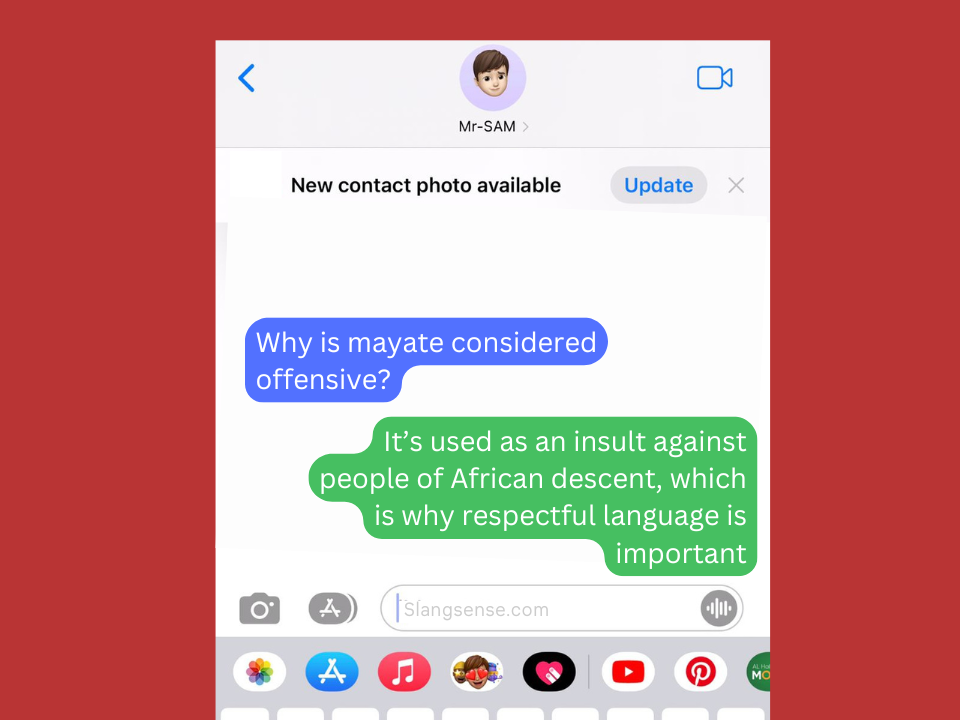
Why Is Mayate Considered So Offensive?
The offense comes from what the comparison implies. Reducing a person to an insect strips away their humanity, and doing it along racial lines carries the added weight of a long history of dehumanizing language aimed at Black communities. That history is why the word does not soften with tone or intention. Even delivered “as a joke,” it lands as a slur, because the underlying comparison — a human being equated with a bug — is the insult, no matter how it is packaged.
The same logic applies to the anti-gay sense. Slang that turns a person’s identity into a punchline, or ties it to shame, causes harm whether or not the speaker thinks they mean it lightly. In both cases the respectful move is identical and simple: do not use the word for people.
A Short History of the Word
The beetle meaning is the oldest, reaching back to the pre-Hispanic Nahuatl term. The anti-gay slang is documented in Mexican prison writing as early as 1904, growing out of a specific subculture and spreading from there. The racial-slur usage became widespread later, taking hold in Mexican-American communities in the United States over the second half of the twentieth century. Across all three, the throughline is the beetle: every slang sense borrows the insect’s image and bends it toward an insult. Understanding that shared origin is the clearest way to see how one small nature word ended up carrying so much baggage.
What to Do If Someone Uses It
If someone directs the word at you or at someone nearby, you are not overreacting by treating it as a slur, because that is what it is. A calm, direct response tends to work best: name it plainly (“that’s a slur”), and step back from the conversation if the person tries to defend it. If you encountered it in a comment or post, most platforms let you report hate speech, and slurs of this kind fall squarely under those policies.
And if you have used the word yourself without knowing its weight — which is common, since many people first meet it with no idea it is a slur — the fix is easy. Stop using it, and if it came up around others, a short “I didn’t realize what that meant, my mistake” goes a long way. Knowing better is the whole point of looking it up.
How to Talk About It With Teens
Because mayate spreads through TikTok, Snapchat, and Instagram, it often reaches teenagers first, and usually without any of the context that explains why it is harmful. If a young person in your life repeats it, the most effective approach is information rather than alarm: explain that it is a real slur with a real history, not just internet slang, and that words like this hurt actual people regardless of intent. Framing it as “here is what this word actually carries” tends to land better than simply forbidding it, and it gives them something to say when they see it used by others.
Frequently Asked Questions
Is mayate a bad word?
Two of its three meanings are slurs, so as a term for a person, yes — it is a bad word and is best avoided. Its only harmless meaning is the literal one: a green beetle.
What does mayate mean in English?
Literally, it translates to figeater beetle or green June bug. As slang it has no polite English equivalent, because the slang meanings are themselves slurs.
How do you pronounce mayate?
It is pronounced mah-YAH-teh, with the stress on the middle syllable.
Why does mayate have more than one meaning?
All three senses trace back to the beetle. Over time, the insect’s image was borrowed to insult people, producing a racial slur in the United States and an anti-gay slur in Mexico, while the literal beetle meaning survived alongside them.
Is mayate the same as the N-word?
They are different words from different languages, but linguists describe the racial meaning of mayate as comparable in severity — a slur that dehumanizes Black people. It is treated with the same seriousness.
Does mayate mean something different in Mexico than in the US?
Yes. In the United States it usually functions as a racial slur for a Black person, while in Mexico it more often refers to the beetle or is used as a slur against gay men. The regional difference is a big reason people disagree about its meaning.
Can mayate ever be used innocently?
Only when it refers to the actual insect. Pointing at a green beetle in the garden and calling it a mayate is completely normal Mexican Spanish. Applied to a person, it is a slur.
The Bottom Line
Mayate is a word with a split personality: a harmless Nahuatl-rooted name for a green beetle that hardened into a slur when it was aimed at people — at gay men in Mexican slang, and, most damagingly, at Black people in Mexican-American communities in the United States. Knowing all three meanings lets you read the word correctly, and knowing which two are slurs is exactly what tells you to keep it out of your own vocabulary. When it comes to describing people, the respectful word is always the better word.