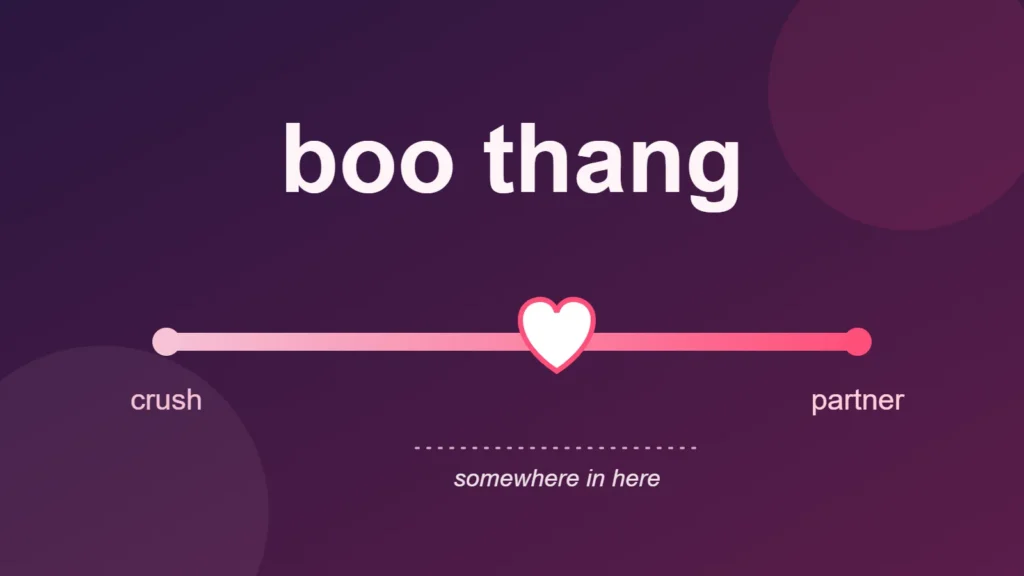
Boo thang is a playful nickname for someone you have romantic feelings for, from a new crush to a steady partner. Boo is slang for a sweetheart, and thang is a relaxed way of saying thing. Some people only call a real partner their boo thang, while others use it for someone special who is not official yet. This guide shows how to tell which one someone means, where the phrase came from, and what to say back.
Does being someone’s boo thang mean you are dating?
Not always, and that is the part that confuses people. Merriam-Webster lists boo as US slang for a romantic partner, with a first known use in 1988, so for many people a boo thang is simply a boyfriend or girlfriend. But the oldest Urban Dictionary entry for the full phrase, posted on 26 October 2007, describes a woman who is not your girlfriend yet shares a bond of respect and affection with you. Many entries added since then say much the same thing: close, flirty and not labeled.
So the phrase covers a range, and the person saying it decides where you sit on that range. The table below sets out the four ways it shows up, with the clue that gives each one away. When the clues do not settle it, the only sure way to know is to ask.
| How it is used | What it means | The clue | Example line |
|---|---|---|---|
| My partner | A boyfriend or girlfriend, named with affection | Said in public, in a caption or about someone they live with | “Date night with my boo thang.” |
| Not official yet | Someone special you are dating or talking to, with no label | Words like “not dating” or “not official” sit close by | “We’re not official, he’s just my boo thang.” |
| Casual, no promises | A fling where one person or both avoid commitment | Said with a shrug, often by someone who dodges labels | “She’s my boo thang for now, nothing serious.” |
| Close friend, as a joke | A best friend, said for fun | Said between friends with no flirting at all | “Movie night with my boo thang, aka my roommate.” |
How do people use boo thang in texts and captions?
Most of the time boo thang shows up in sweet or joking moments, not in serious talks. People put it in captions under couple photos, in comments on TikTok and in texts to the person they like. It often comes with “my” or “lil” in front, which makes it sound even softer. The example lines below show the two most common readings side by side.
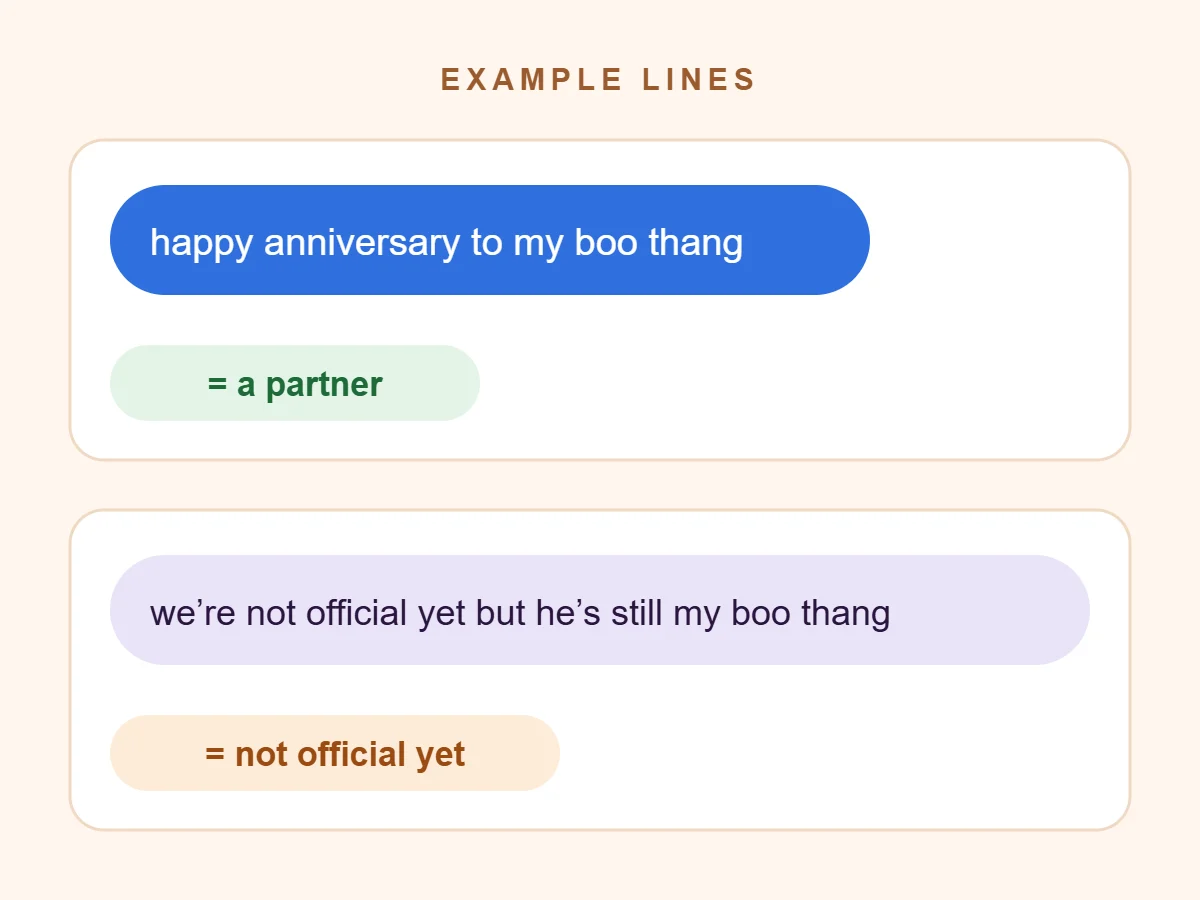
Notice how the words around the phrase do the work. In the first line the speaker is marking an anniversary, so the boo thang is clearly a partner. In the second, “not official” tells you the two are close but have not agreed to date. If a message mixes in other slang too, our Gen Z slang translator can turn the whole thing into plain English.
What does “lil boo thang” mean in the Paul Russell song?
Lil Boo Thang is a song by the rapper Paul Russell, released on 18 August 2023 by Arista Records. He first shared a clip of it on TikTok on 28 June 2023, and the clip went viral before the full song came out. It samples “Best of My Love,” a 1977 hit by the Emotions, which gives it a bright disco sound. The song climbed to No. 14 on the Billboard Hot 100 in January 2024, according to its Wikipedia page.
In the song, the boo thang is a partner, not a maybe. Wikipedia reports that Russell told Genius the phrase means a partner in a caring, romantic relationship. The hit is a big reason the phrase feels fresh to younger people, even though it is much older than the song. Many people who look up the phrase today heard it there first.
An earlier song used the phrase too. “Boo Thang” by Verse Simmonds featuring Kelly Rowland came out on 13 September 2011 and reached No. 44 on Billboard’s Hot R&B/Hip-Hop Songs chart. So when someone says boo thang, they may be quoting a song, or they may just be using slang that was common long before either one.
Where does the phrase boo thang come from?
The phrase joins two older slang words, and the first one has a murky past. Boo, meaning a sweetheart, goes back to the late 1980s: Merriam-Webster dates it to 1988, and Green’s Dictionary of Slang, which labels it US Black slang, gives its earliest example from a 1990 song by the rapper Grand Daddy IU. Thang is older still, and Merriam-Webster dates it to 1932 as a spelling of thing. The spelling reflects how some African American and Southern speakers say the word.
Nobody knows for sure where boo itself came from, and the dictionaries do not agree. Dictionary.com says it may come from the French word beau, which means boyfriend or admirer. Merriam-Webster suggests it may be a pet form of brother, while Green’s leans toward baby. Any guide that states one of these as fact is guessing.
The full phrase was in use by the late 2000s. Urban Dictionary entries for it start in 2007, and the first printed example in Green’s comes from a list of campus slang collected at the University of North Carolina in 2011. From there, songs and social media carried it into everyday talk.
Is boo thang flirty, rude or safe for work?
Boo thang is warm and flirty, and it is almost never rude. Calling someone your boo thang tells them, and anyone listening, that you like them as more than a friend. Like cutie patootie, it is a sweet pet name, but it is more romantic and less of a family word. It is too playful for a work chat, a school email or anything formal.
For parents and teachers, boo thang is a cute way of naming a crush or a partner, not a coded or sexual phrase. A few joke entries online give crude meanings to the spelling “boo tang,” but that is not how people use the common phrase. If a teen calls someone their boo thang, it usually just means they like that person. A gentle question about who it is will tell you more than the word itself.
How should you reply when someone calls you their boo thang?
The right reply depends on how you feel and on what you think they mean. Pick the case that fits below and open it to see a few lines you can send. Each one keeps things light, because boo thang is a light phrase. If the label really matters to you, it is fine to ask straight out.
You like them back
Match their energy and keep it sweet.
Try: “Only if you’re my boo thang too.” Or: “Aww, I like the sound of that.”
You want to know where you stand
Asking is not awkward here, because the phrase really can mean either one.
Try: “Boo thang as in we’re dating, or as in we’re still figuring it out?” Or: “I like that. So what are we, exactly?”
A friend is joking around
Play along. Between friends it is a joke, not a hint.
Try: “Love you too, bestie.” Or: “Okay, boo thang, where are we eating?”
You don’t feel the same way
Be kind but clear, because a vague or flirty answer can sound like a yes.
Try: “That’s sweet, but I see us as friends.” Or: “I’m flattered, but I’m not looking for that right now.”
How is boo thang different from boo, bae and situationship?
Boo thang belongs to a family of pet names and relationship words, and each one says something a little different. Merriam-Webster defines both boo and bae as names for a romantic partner, and it defines a situationship as a connection where neither person is sure how committed the other is. Boo thang can name the person in a situationship, which is why the two words often show up together. Our Gen Z slang list collects more words like these in one place.
| Word | What it means | Does it say you are dating? |
|---|---|---|
| Boo thang | A sweetheart, anywhere from a crush to a partner | Sometimes |
| Boo | A romantic partner, US slang since the late 1980s | Usually |
| Bae | A sweetheart, much like “baby” | Usually |
| Situationship | A romantic link with no clear commitment | No, that is the point |
Last checked: October 27, 2026.