
Pun intended means the speaker made a play on words on purpose and wants you to notice it. No pun intended means the opposite: the double meaning was an accident, or at least that is the claim. People tack either phrase onto a line, often in parentheses, as in “I’m reading a book about glue, and I can’t put it down (pun intended).” Both phrases shine a spotlight on the joke so nobody misses it.
Unlike most entries in our list of Gen Z slang words, these phrases are old, and people of every age use them. They are not always used the way the words suggest, though. Plenty of people say “no pun intended” right after a pun they clearly planned, which turns the phrase into a wink. To read both phrases well, it helps to start with what a pun actually is.
What counts as a pun?
Merriam-Webster describes a pun as a usually funny use of a word that hints at two of its meanings, or at another word that sounds the same. In other words, one word does two jobs at once. Some puns use a single word with two senses, while others swap in a word that only sounds alike. The table shows three common shapes.
| Kind of pun | How it works | Example |
|---|---|---|
| One word, two meanings | A single word fits two ideas at once | “I used to be a banker, but I lost interest.” |
| Sound-alike words | Two words sound the same but mean different things | “A bike can’t stand on its own because it’s two tired.” |
| A phrase with a double reading | A common saying also fits the topic | “The pasta chef got into hot water.” |
Pun intended, no pun intended or pardon the pun: which one fits?
| Phrase | What it claims | How it often sounds | Example |
|---|---|---|---|
| Pun intended | I made this joke on purpose | Proud and playful | “Our garden club keeps growing (pun intended).” |
| No pun intended, said honestly | The double meaning slipped out by accident | Quick and a little sheepish | “This bridge project has a lot riding on it, no pun intended.” |
| No pun intended, said with a wink | Pretends the joke was an accident | Sly, tongue in cheek | “Our cheese shop had a grate year, no pun intended.” |
| Pardon the pun | Sorry for the joke I am about to make, or just made | Mock-apologetic and a bit cheesy | “Pardon the pun, but the bee exhibit was un-bee-lievable.” |
The first and last phrases are easy to read, because nobody uses them by accident. No pun intended is the tricky one, since it has two lives, one honest and one sly. The same three words can mean “oops” or “see what I did there?” The next section shows how to tell which one you are looking at.
Why do people say “no pun intended” after an obvious pun?
Wiktionary notes that “no pun intended” is also used sarcastically, to stress a pun that was very much intended. If someone writes “our cheese shop had a grate year, no pun intended,” the odd spelling of great gives the game away. The phrase becomes a fake denial, like a magician saying there is nothing up their sleeve. It lets the speaker enjoy the joke while acting innocent.
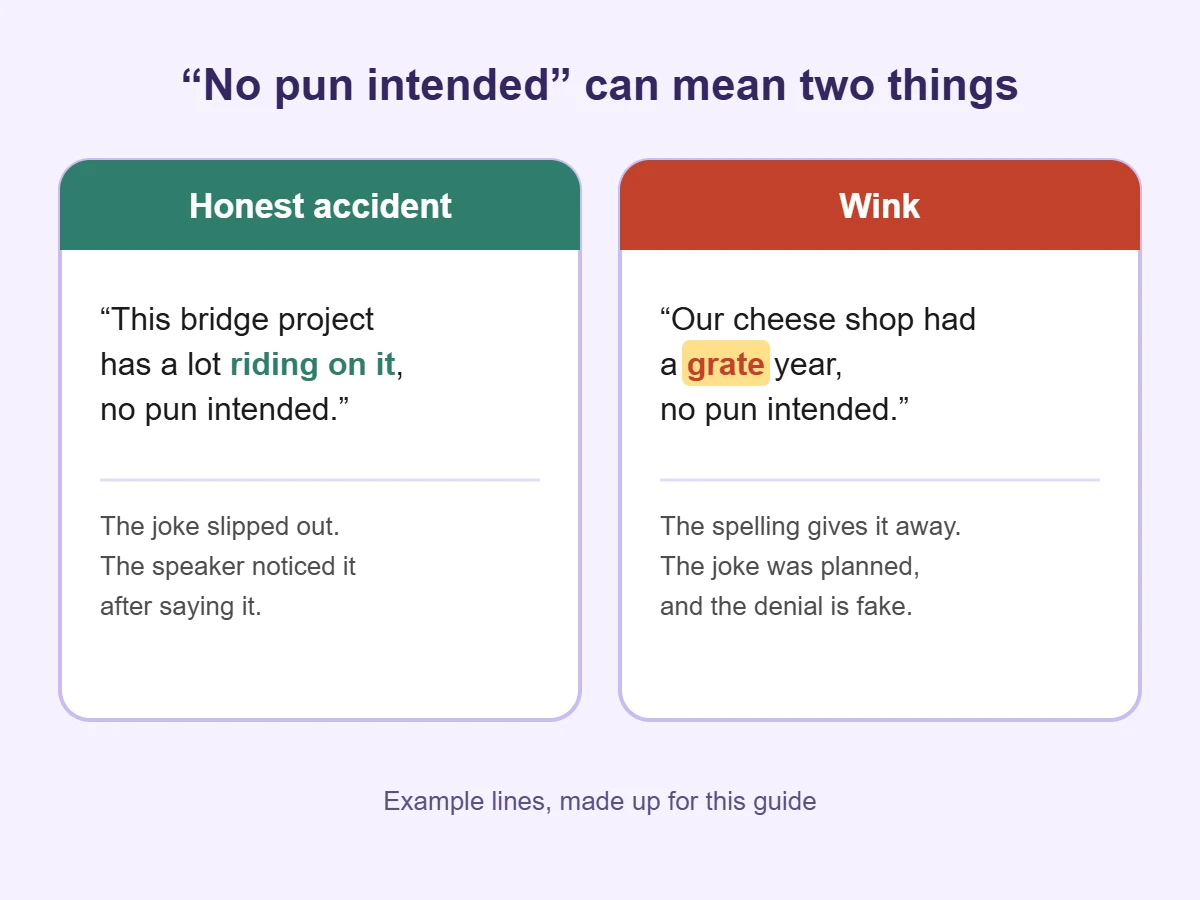
Honest accidents happen too, and they are often funnier. A speaker might say a bridge project has “a lot riding on it” and only then hear the double meaning. Adding “no pun intended” in that moment shows they caught it before anyone else could. A real accident tends to sound natural, while a planned one usually feels a bit too neat.
Sometimes the accidental double meaning is not clean at all. A line that sounds rude or sexual by mistake often gets a teasing “ayo?” online, which means hold up, that sounded wrong. In that case, “no pun intended” is a quick way to say the speaker meant nothing by it. Saying it calmly usually works better than a long apology.
Where does the phrase go in a sentence?
The usual spot is right after the pun, set off by parentheses, a comma or a dash. “I can’t put it down (pun intended)” is the classic shape. Pardon the pun is different, because it often comes first, as a warning that a groan is on the way. In speech, people simply pause before tacking the phrase on.
Where does the word pun come from?
The word pun is old. Merriam-Webster dates the noun to 1644 and the verb, to pun, to 1670. Etymonline gives the 1640s for the noun and says the earliest use seems to refer to a hidden play on Thames and tame. It also finds the verb by the 1660s in the writing of John Dryden, so the two sources differ a little on the verb’s date.
Where the word itself came from is unclear. Merriam-Webster says it may come from the Italian puntiglio, meaning a fine point or quibble, while Etymonline calls that idea pure speculation. Etymonline also names another rare old word as a possible source, though that word’s origin is a mystery too. Later spin-offs include punster, recorded by 1700, and punny, by 1961.
Nobody has pinned down when “pun intended” or “no pun intended” first appeared. Some websites claim the 1700s or 1800s but give no source, so we are leaving that out. Wiktionary’s sample quote for “no pun intended” comes from “Tommy the Cat,” a 1991 song by the band Primus. That shows the phrase was well known by then, even if its first use is still unknown.
How should you reply to a pun?
A groan is the classic reply, and most people who make puns are hoping for one. With friends, you can answer with a pun of your own or a dry “I see what you did there.” If someone says “no pun intended” with a wink, playing along with “sure it wasn’t” shows you caught it. At work, a short smile or a thumbs-up is plenty.
There are also times to skip the phrase. In formal writing, such as an essay or a report, the pun itself is usually a risk, and flagging it draws even more attention. The phrase also falls flat when there is no real double meaning, so check that both readings work. If the joke is good, readers will spot it without help.
Can you tell an intended pun from an accident?
Try these four quick questions to test what you just read. Each answer shows a short reason, so you will know why it is right even if you miss it. They cover the wink, the classic pun shape and one date from the history above. If you enjoy this kind of test, our Gen Z slang quiz mixes 10 questions a round across three levels.
1. “I’m reading a book about anti-gravity. It’s impossible to put down.” Which tag fits best?
(pun intended). The whole line was built around the double meaning of “put down,” so the speaker clearly planned the joke.
2. “Our cheese shop had a grate year, no pun intended.” What is the speaker doing?
Joking that it was an accident when it clearly was not. The spelling “grate” shows the pun was planned, so “no pun intended” is a wink, the sarcastic use Wiktionary describes.
3. True or false: Merriam-Webster dates the word pun back to 1644.
True. Merriam-Webster gives 1644 as the first known use of the noun, and Etymonline also points to the 1640s.
4. When is “no pun intended” the wrong choice?
After a line with no double meaning at all. The phrase only makes sense when a word can be read two ways, so tagging a plain line falls flat.
Last checked: October 19, 2026.