
No bueno means “not good.” It is American English slang made from two Spanish words, and people use it for a bad idea, bad news or a thing that is broken. A friend who texts “traffic is no bueno” is just saying the traffic is bad. It sounds Spanish, but it is not how Spanish speakers say it.
What does no bueno mean in English?
It means something is bad, wrong or not working. Dictionary.com lists it as an American phrase that means “not good; not pleasing or desirable.” It also lists it as a quick reaction word, the kind you say when you hear bad news. The tone is light, a bit jokey, and never formal.
- As a verdict: “Three exams in one day is no bueno.”
- As a reaction: “You lost your keys? No bueno.”
- About a broken thing: “The wifi is no bueno right now.”
- About a feeling: “My stomach is no bueno after that burrito.”
Newspapers use it too. Dictionary.com quotes the Washington Post in April 2020 with the line “Long-term commitments are no bueno.” It also quotes Golf Digest and the Seattle Times. So the phrase has moved from casual talk into print, at least in relaxed writing.
Is no bueno correct Spanish?
No. Both words are real Spanish, but they do not make a full sentence on their own. Spanish needs a verb in the middle, either “ser” or “estar,” which both mean “to be.” Babbel’s language writer Thomas Moore Devlin calls no bueno “an incomplete sentence” and a clear American habit.
There is a second snag. “Bueno” is an adjective, a word that describes a thing, while “bien” is an adverb, a word that describes how something is going. English uses “good” for both jobs in casual talk, so the mix-up is easy to make. A Spanish speaker will still understand you, but the phrase marks you as a learner.
What would a Spanish speaker say instead?
It depends on what is not good. Spanish picks a different short sentence for a bad idea, a broken thing or a sick feeling. English slang squeezes all of them into one phrase. The table matches each use to natural Spanish.
| What is wrong | How the slang sounds | Natural Spanish |
|---|---|---|
| A plan or habit is a bad idea | “Skipping the test? No bueno.” | No es bueno. (It is not good.) |
| Something is unfair or not okay | “Lying to her was no bueno.” | No está bien. (It is not okay.) |
| Something is plain bad or wrong | “That call by the ref was no bueno.” | Está mal. (It is bad or wrong.) |
| A thing is broken | “My laptop is no bueno.” | No funciona. (It does not work.) |
| You feel sick | “My stomach is no bueno.” | No me siento bien. (I do not feel well.) |
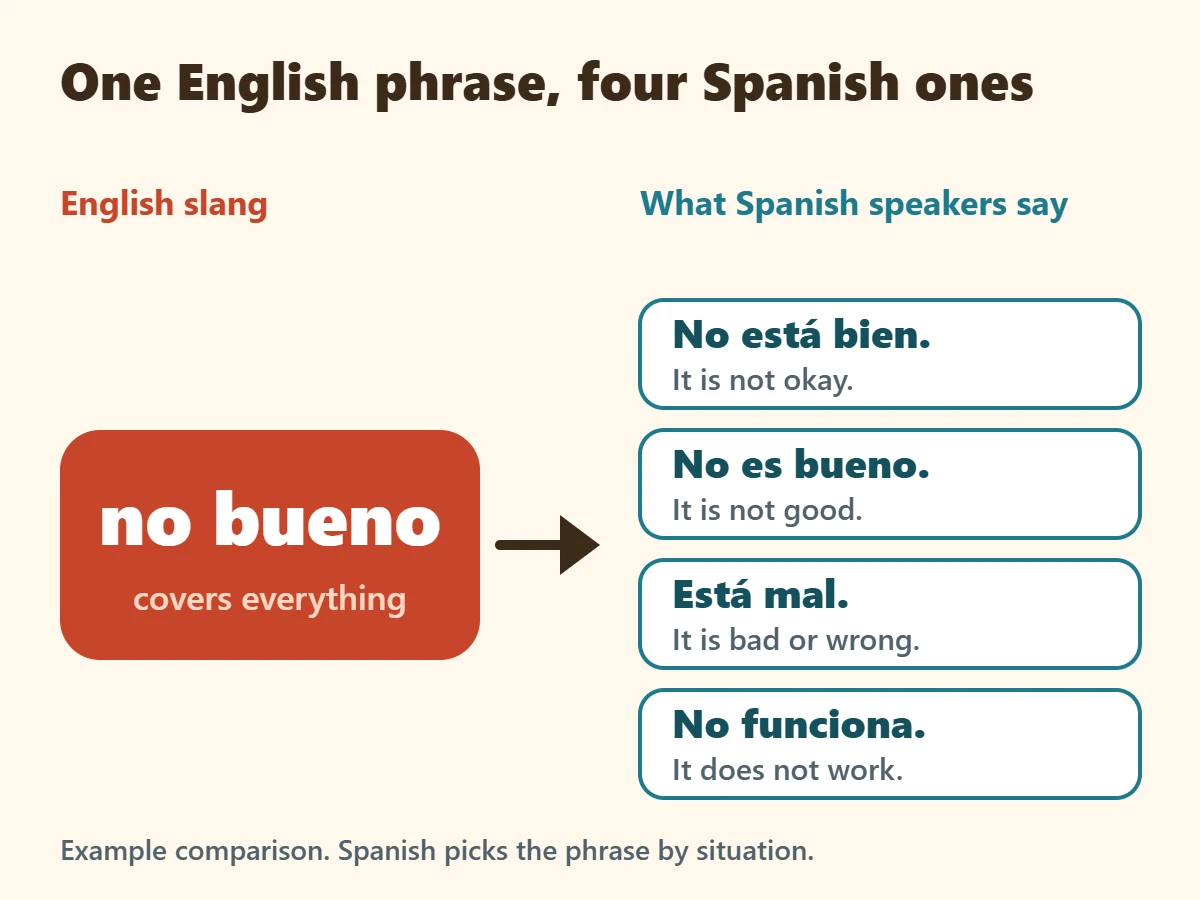
The first two rows look alike, and the gap between them is small. The grammar site Spanish Unraveled says “no está bien” is more of a personal opinion, while “no es bueno” is about what a thing is like by nature. It adds that the two can often be swapped, so either is a safe stand-in. To check a Spanish phrase someone sent you, try the Spanish Slang Translator.
Is no bueno offensive?
Most people who say it mean no harm, and many listeners take it as a joke. Still, it belongs to a family of phrases that some people dislike. Linguist Jane Hill of the University of Arizona wrote about this family in 1995 and called it Mock Spanish. Her examples were phrases like “no problemo” and “el cheapo,” where English speakers play with Spanish sounds for a laugh.
Hill argued that these jokes can carry a put-down even when the speaker means none. She showed examples to Mexican-Americans and wrote that some, mostly very young, found them entertaining. Older people, she wrote, were “almost unanimous” in reacting negatively. Her paper does not name no bueno itself, so the link here is by likeness only.
Babbel gives similar advice for travelers. It warns that mock Spanish can be “annoying or offensive” to Spanish speakers. None of this makes no bueno a slur. It does mean the phrase is safer among friends who use it too than aimed at someone because they speak Spanish.
When is no bueno fine, and when should you skip it?
A simple rule works. Use it the way you would use any jokey slang, with people who talk that way too. Skip it when it could look like you are making fun of how someone speaks. These cases cover most of daily life.
- Fine: with friends who say it too, about your own bad day
- Fine: in a casual text about traffic, weather or a dead phone
- Skip: when you are speaking Spanish, where the real phrase works better
- Skip: said to a Spanish speaker you do not know, as a way to “speak their language”
- Skip: at work with clients, in school essays and in anything formal
How do you reply to no bueno?
Treat it like “that’s not good.” The person is sharing a small problem or turning down an idea. You can show you care, offer a fix or just agree. A short, warm reply is all it needs.
- To bad news: “ugh, sorry. anything I can do?”
- To a broken plan: “no worries, want to move it to Friday?”
- To a joke about their day: “no bueno at all, hang in there”
- To a no on your idea: “fair, what would work better?”
Where did no bueno come from?
We could not find a dated first use that is free to read. Dictionary.com gives no origin for it, and the Oxford English Dictionary entry sits behind a paywall. On Urban Dictionary, the oldest entries we could see that use the phrase date from 2006 and 2009. That tells us it was common slang by then, not when it began.
It has turned up in pop music too. Singer Nadia Oh released a single called “No Bueno” on September 4, 2011. You may read online that the phrase dates to the 1940s or the 1960s. We could not find a source for either date.
Which Spanish words in English slang are real?
No bueno is English wearing a Spanish coat, but plenty of real Spanish words travel into English chat too. Chisme, which means gossip, is one you will see all over social media. Unlike no bueno, it is a real Spanish word with the same meaning. Knowing which is which keeps you from guessing.
The mock side of the family is easy to spot. “No problemo” puts an O where Spanish has an A, and Babbel gives the real phrase as “no hay problema.” “El cheapo” does a similar trick with an English word. If a phrase sounds like a cartoon of Spanish, it probably is one.
Real praise in Spanish slang has its own phrases as well. One friendly example is está chulo, which people use to say something is cool or pretty. It is the bright twin of a complaint. Where an English speaker reaches for no bueno on a bad day, this is what a good day sounds like.
Last checked: October 5, 2026.